Showing posts with label prayer. Show all posts

Monday, February 10, 2014

".....both the object being sought and the relentless seeking itself....."

Victor Hori comments:
...in the beginning a monk first thinks a kōan is an inert object upon which to focus attention; after a long period of consecutive repetition, one realizes that the kōan is also a dynamic activity, the very activity of seeking an answer to the kōan. The kōan is both the object being sought and the relentless seeking itself. In a kōan, the self sees the self not directly but under the guise of the kōan ... When one realizes ("makes real") this identity, then two hands have become one. The practitioner becomes the kōan that he or she is trying to understand. That is the sound of one hand.

Friday, January 3, 2014

"Mary, Untier of Knots"

This is an oil painting, c. 1700, by German artist  Johann George Melchior Schmidtner, currently, it appears to belong to the church of  St. Peter am Perlach, in Augsburg, Germany (and is probably displayed there).  According to Wikipedia's article on the topic, it:
shows the Blessed Virgin Mary standing on the crescent moon (the usual way of depicting Mary under her title of the Immaculate Conception), surrounded by angels and with the Holy Spirit Dove hovering above her circle of stars as she unties knots into a long strip and at the same time rests her foot on the head of a "knotted" snake.


Pray Tell Blog is running a series on this topic/devotion at the moment; it seems to be a way to seek for help and release from what seem to be "impossibly complicated problems" - and perhaps also simply from "the evil powers of this world which corrupt and destroy the creatures of God."

Here's today's entry:
Mary, undoer of knots, help us break the knot of fear: it strangles the hearts of children who live daily with gunfire on their streets; of women who endure rape in war-torn cities and countrysides; of starving men and women who watch their children grow hungrier each day; of soldiers, aid workers and first responders whose daily battle with PTSD haunts their waking hours and turns their dreams into nightmares.

Mary, undoer of knots, help us untie the knot of addictions that consume persons and families: addictions to alcohol, drugs, sex, spending, work, food.

Mary, undoer of knots, help us unbind the knot of illiteracy and lack of education, particularly for women and girls.

Mary, undoer of knots, help us untie the knot of hiding. So many of my brothers and sisters are hiding: the divorced and remarried couples who have succumbed to their longing for Eucharist and dare not divulge their status; the gay and lesbian persons who are frightened that someone will out them in a community that doesn’t know what to make of them; the women who fear even to discuss their call to orders.

Mary, undoer of knots, help us untie the knot of distrust that erodes global and intimate relationships, and alienates friends, spouses, parents and children, pastors and people, leaders of communities and their constituencies.

Mary, undoer of knots, help us untie the knots of illness, physical and mental, that afflict so many in our communities.

Mary, undoer of knots, help us untie the knots of homelessness and poverty, of despair, and meaninglessness. Help us re-weave the broken bonds that lead to loneliness and isolation.

Mary, undoer of knots, help us untie the knots of dispossession and loss of identity that are destroying the aboriginal people of my land.

Mary, undoer of knots, help us untie the knots of excommunication: of thoughtful people, young and old, who must hide their questions about the status quo – be it religious or political – lest they be shunned; the women and men who have had abortions and cannot speak their reality lest they be ostracized; of those whose actions make them fear that they are beyond God’s mercy and ours.

Mary, undoer of knots, help us untie the knot of consumerism that distorts our desire for God and for each other.


I first read about this devotion in something James Alison wrote years ago:
I recently came across what was, for me, an entirely new and wonderful avocation of Our Lady. This is Our Lady Undoer of Knots. I stumbled upon a locally carved statue of her in Brazil, which I bought without knowing anything about the devotion. This turns out to come from Augsburg in Germany, from a painting by an unknown artist dating from 1700. What on earth, you may ask, is a devotion from a Baroque part of Germany doing being sculpted in Salvador, the most African part of Brazil? But this is part of the uncanny wonder of the Catholic Church. The image is of Our Lady of the Immaculate Conception holding a cord with knots, which she is undoing. This Avocation gives me great peace, since it is clear to me that the knots concerning the relationship between grace and desire, sin and concupiscence, which have been so tied up into a skandalon for gay people in the life of our Church are being gently and carefully undone by hands blessed with far more patience and delicacy than I could hope to muster.


Here's more of Wikipedia's article on the topic:
Mary Untier of Knots or Mary Undoer of Knots is the name of both a Marian devotion and a Baroque painting (German: Wallfahrtsbild or Gnadenbild) which represents that devotion. The painting by Johann Georg Melchior Schmidtner, of around 1700, is in the Catholic pilgrimage church of St. Peter am Perlach, otherwise known as the Perlach church, in Augsburg, Bavaria, Germany. Pope Francis saw the image while in Germany as a student and promoted her veneration in Latin America.

Painting

The painting, executed in the Baroque style by Johann Georg Melchior Schmidtner (1625 – 1707), shows the Blessed Virgin Mary standing on the crescent moon (the usual way of depicting Mary under her title of the Immaculate Conception), surrounded by angels and with the Holy Spirit Dove hovering above her circle of stars as she unties knots into a long strip and at the same time rests her foot on the head of a "knotted" snake. The serpent represents the Devil, and her treatment of him fulfills the prophecy in Genesis 3:15: "[thy seed] shall bruise the serpent’s head".

Below are shown a human figure and his dog accompanying a much smaller angel. This scene is often interpreted as Tobias with his dog and the Archangel Raphael traveling to ask Sara to be his wife.[1]

The concept of Mary untying knots is derived from a work by St. Irenaeus of Lyons, Adversus haereses (Against Heresies). In Book III, Chapter 22, he presents a parallel between Eve and Mary, describing how "the knot of Eve's disobedience was loosed by the obedience of Mary. For what the virgin Eve had bound fast through unbelief, this did the virgin Mary set free through faith."[2]

The two small figures have also been interpreted as a representation of Wolfgang Langenmantel, the grandfather of the benefactor, guided in his distress by a guardian angel to Father Jakob Rem in Ingolstadt.[1]

History

The painting was donated around 1700 by Hieronymus Ambrosius Langenmantel (1641 – 1718),[3] a canon of the Monastery of Saint Peter in Augsburg. The donation is said to be connected with an event in his family. His grandfather Wolfgang Langenmantel (1586 – 1637) was on the verge of the separation from his wife Sophia Rentz (1590 – 1649) and therefore sought help from Jakob Rem, the Jesuit priest in Ingolstadt. Father Rem prayed to the Blessed Virgin Mary and said: “In diesem religiösen Akt erhebe ich das Band der Ehe, löse alle Knoten und glätte es [In this religious act, I raise the bonds of matrimony, to untie all knots and smoothen them]”. Immediately peace was restored between the husband and wife, and the separation did not happen. In the memory of this event, their grandson commissioned the painting of the “Untier of Knots”.

Devotion

The first Chapel to be named "Mary Untier of Knots" was completed in 1989 in Styria, Austria, inspired as a supplication in response to the Chernobyl Nuclear Tragedy.[4] The image of "Mary Undoer of Knots" is especially venerated in Argentina and Brazil,[1] where churches have been named for her and devotion to her has become widespread and which the Guardian called a "religious craze".[5]

This Catholic devotion has grown since Jorge Mario Bergoglio, S.J. (later Archbishop of Buenos Aires and Pope Francis), brought a postcard of the painting to Argentina in the 1980s after seeing the original while studying in Germany.[6][7][8] The devotion reached Brazil near the end of the 20th century. According to Regina Novaes, of the Institute of Religious Studies in Rio de Janeiro, Mary Untier of Knots "attracts people with small problems".[5] Bergoglio had this image of Mary engraved on a chalice he presented to Pope Benedict XVI and another chalice bearing her image, the work of the same silversmith, is to be presented to Pope Francis on behalf of the Argentine people.[6]

In Buenos Aires, a copy of the icon was made and left by the artist, Dr. Ana de Betta Berti,[9] for the Church of San José del Talar, which has had it since 8 December 1996. Every eight months, thousands of people make the pilgrimage to this church.[10]

It's quite a beautiful image, and I offer it here simply for contemplation; it reminds me very strongly of  what's taught in A.A., about "letting go" of those complex and knotty things that are being unwound slowly - but that we might otherwise try to force to immediate resolution (see also "God grant me the serenity to accept the things I cannot change; courage to change the things I can;and wisdom to know the difference.").

James Alison also writes, in the same article (Is it ethical to be Catholic? – Queer perspectives"):
But I have come to rejoice in and love Our Lady and the difference which she constitutes in the Church. For it is she who makes it impossible for the Church successfully to turn itself either into an ideology or into a moralistic enterprise. She can never quite be co-opted into standing for something other than what she is. And what I have come to associate her with being is the link, the non-opposition, between the old creation and the new, between nature and grace, between the Israel of the Prophets and Patriarchs and the new, universal Israel of God. Far too delicate to be clearly delineated, and far too present to be dismissed, she has underlined, seated, and made three-dimensional for me elements of the faith in what her Son is doing which can only be lived-into over time.

And I do like that thing about Mary "making it impossible for the Church successfully to turn itself either into an ideology or into a moralistic enterprise" - which of course the Church is now doing and has been doing for quite awhile.  This, I think, is the main reason so many dislike it so much these days, in fact.

I like his point that Mary "cannot be co-opted"; that to me is a tremendously interesting idea - although I'm not particularly big on Marian devotions, and frankly know little about them, myself.    This one, though, appeals very much to me - perhaps because everything at the moment is in truth so knotted and oppositional.

Here's an article on a "Novena to Mary, Undoer of Knots".


Sunday, September 1, 2013

Heard today at Divine Service...

A prayer in honor of Labor Day,  Collect II ("For Commerce and Industry") of Rogation Days:
Almighty God, whose Son Jesus Christ in his earthly life shared our toil and hallowed our labor: Be present with your people where they work; make those who carry on the industries and commerce of this land responsive to your will; and give to us all a pride in what we do, and a just return for our labor; through Jesus Christ our Lord, who lives and reigns with you, in the unity of the Holy Spirit, one God, now and for ever. Amen.

We also had a prayer "For a Birthday," just after the Peace; this is done once monthly.  Those with birthdays in September came to the transept and stood togther as we all prayed:
Watch over your children, O Lord, as their days increase; bless and guide them wherever they may be. Strengthen them when they stand; comfort them when discouraged or sorrowful; raise them up if they fall; and in their hearts may your peace which passes understanding abide all the days of their lives; through Jesus Christ our Lord. Amen.

And this one, taken from the Book of Occasional Services' "Anniversary of a Marriage", also done once a month, to celebrate couples whose anniversaries come during September.  The couples stood in place in their seats as we all said the prayer:
Gracious God, we ask your blessing upon these your servants.  Lead them further in companionship with each other and with you.  Give them grace to live together in love and fidelity, with care for one another.  Strengthen them all their days, and finally bring them to that holy table where, with those they love, they will feast for ever in their heavenly home, through Jesus Christ our Lord.  Amen.

See how it all fits together?


Wednesday, July 31, 2013

"Cassian: Discipline in Prayer"

Derek posted something at haligweorc last week that astounded me.  It's so beautifully simple, and brings together, via prayer, some of what I see as the most central ideas in the life of faith:  "conscious contact with God"; living "a day at a time" - and at the same time in expectation of something greater; the dynamic process of "preparation"; simplicity; having and living a "primary purpose."  Other things, too, I think, which I'm having trouble articulating at the moment.

Here's his post; he's talking about his current Prayer Book Spirituality project:
In doing some research for the next section, I ran again across this passage which was marked with double lines, underlines, and a star in the margin in my copy of the Conferences and which must be shared:
For whoever is in the habit of praying only at the hour when the knees are bent prays very little. But whoever is distracted by any sort of wandering of heart, even on bended knee, never prays. And therefore we have to be outside the hour of prayer what we want to be when we are praying. For the mind at the time of its prayer is necessarily formed by what went on previously, and when it is praying it is either raised to the heavens or brought low to the earth by the thoughts on which it was dwelling before it prayed. (John Cassian, Conferences 10.14.2)

What's really stunning to me is that I've never heard of this before!   I mean, there are dozens of contemplative prayer disciplines and techniques (or, as Keating calls Centering Prayer, methods) - some of which are quite elaborate.  Yet this, from John Cassian - and the 4th century - seems somehow never to have made that list.  Perhaps it's just too simple.

This idea takes a person's day-to-day life and in one simple idea sweeps it up into the life of prayer and aspiration - all by means of simply recalling the process itself to itself.  It is, really, I believe, the way to "prayer without ceasing."


Tuesday, July 16, 2013

"Fasting and freedom: Returning to the meaning of Ramadan"

At ABC Religion & Ethics; my bolding.   Fasting, prayer and meditation, self-examination, and other ancient practices aren't just "things to do."  They've been used (and passed down) for important reasons.  These things have a purpose for people who wish to become more aware of their own spiritual natures and thus of their relationship with God; of their own actions and behaviors; and of the nature of the greater world in which they live.  They are time-tested means to help develop peoples' spiritual (and communal) lives.   As A.A. points out (about self-examination and confession) they have been "validated in every century, and [characterize] the lives of all spiritually centered and truly religious people."
The month of Ramadan has begun, Muslims have entering into one of the finest and most beautiful schools of life. The fasting month is a school of faith, spirituality, awareness, giving, solidarity, justice, dignity and unity. Nothing less. It is the month when introspection among Muslims should be deepest; the month of their greatest contribution to humanity.

The month of Ramadan is the world's most widespread fast and yet its teachings are minimised, neglected and even betrayed (through literal application of rules that overlooks their ultimate objective). Small wonder, then, that we should return to the subject and as the fasting month returns each year, we too must repeat, rehearse and deepen further our understanding of what Ramadan teaches us of this school of divine nearness, of humanity and dignity.

The fast is each individual's quest for the divine - it asks of each of us to look beyond self. Ramadan is, in its essence, a month of humanist spirituality. During the fasting days, we are called upon to abstain from eating, drinking and responding to our instincts, to help us turn inward, to our heart and the meaning of our lives. To fast means to experience sincerity, to observe our shortcomings, contradictions and failings - no longer to attempt to hide or to lie and instead to focus our efforts on the search for ourselves and for the meaning and priorities of our lives.

Beyond food, fasting requires us to examine ourselves, to recognise our limits humbly and to reform ourselves ambitiously. It is a month of renewal, of critically summing up our lives, our needs, our forgetfulness and our hopes. We must take time for ourselves, to look after ourselves, to meditate, to contemplate, simply to reflect and to love.

Seen in this light, the month of Ramadan is the best possible expression of anti-consumerism: to be and not to have, to free ourselves of the dependencies that our consumption-based societies not only stimulate but magnify. In calling upon us to master our instincts, the fast calls into question the modern notion of freedom. What does it mean to be free? How are we to find our way to a deeper freedom and move beyond what we crave? The true fast is at odds with appearances.

The tradition of fasting was prescribed, the Qur'an tells us, for all religious traditions before Islam. It is a practice we share with all spiritualities and religions and as such it bears the mark of the human family, the human fraternity. To fast is to participate in the history of these religions, a history that possesses a meaning that has its own demands upon us and that is shaped by destinies and by ultimate goals.

Islam places it in the meaning of tawhid, the recognised and acknowledged "Oneness of God" that opens onto human diversity by virtue of how it is experienced and lived. The same holds true among Muslims. The time frame and the rhythm of those who fast are similar; the cultures of fast ending, of meals and of the night are diverse. In other words, there is unity in meaning, diversity in practice. The month of Ramadan carries with it this fundamental teaching and reminds Muslims, whether Sunni or Shi'ite, irrespective of which school they follow, that they share the same religion and that they must learn to know - and to respect - one another.

This month is a month of dignity, for "Revelation" reminds us that a human being is a creature of nobility and dignity: "We have bestowed dignity of the children of Adam [all humankind]." Only for them, in full conscience, is fasting prescribed; only they are called upon to rise to its lofty goal.

Human beings must undertake the fast in a spirit of seeking nearness to the unique - in a spirit of equality and nobility among their fellows, women and men alike, and in solidarity with the downtrodden. The core of life thus rediscovered is this: to return to our hearts, to reform ourselves in the light of what is essential and to celebrate life in solidarity; to experience deprivation as desired; to reject poverty as imposed and degrading. Our task is one of self-mastery - we must lift ourselves up, sever our ties, become free and independent, above superficial needs, and concern ourselves with the true, down-to-earth needs of the poor and the needy.

The month of Ramadan is thus a place of exile from illusion and fashion and a pilgrimage deep into one's self, into meaning, into others. To be free of ourselves and at the same time to serve all those imprisoned by poverty, injustice or ignorance. Muslims spend thirty days in the company of this month of light. If only they could open even wider their eyes, their hearts and their being to receive the light and offer it in the form of the greatest gift of their spiritual tradition to their sisters and brothers.

Muslims are called to exercise self-control and to give, to meditate and to weep, to pray and to love. Truly to fast is to pray; to pray is to love.

A.A. says, too, about meditation and prayer, that "The actual experience of meditation and prayer across the centuries is, of course, immense. The world's libraries and places of worship are a treasure trove for all seekers."

It also points out that "Those of us who have come to make regular use of prayer would no more do without it than we would refuse air, food, or sunshine. And for the same reason. When we refuse air, light, or food, the body suffers. And when we turn away from meditation and prayer, we likewise deprive our minds, our emotions, and our intuitions of vitally needed support. As the body can fail its purpose for lack of nourishment, so can the soul. We all need the light of God's reality, the nourishment of His strength, and the atmosphere of His grace. To an amazing extent the facts of A.A. Life confirm this ageless truth."

Sometimes it's just necessary to point to the pragmatic, experiential aspect of religion:  to why we do these things, not just to the how.   And that religion is a set of practices that have a valid basis in reality - practices that have been used for millennia, developed by human beings for specific reasons, and "validated throughout every century." 

Monday, July 8, 2013

"The practice of self-discovery"

Here's another very interesting citation from Wonderfully Created, Wonderfully Restored:
 “Our only available starting point for the practice of self-discovery is our wants and desires as we actually experience them. Therefore, Thomas [Aquinas] says, we ought to pray for what we think we want regardless. For prayer is in a certain manner a hermeneutic of the human will, so that by way of placing our desires as we experience them before God we are asking also that those desires be unfolded, explicated, thereby to release their real significance, the real want that is wrapped up in, implicated in all their opacity in their form as experienced. Therefore, says Thomas, we ought to pray, as Jesus did in the garden of Gethsemane, in response to our animal desire (secundum sensualitatem). For when we pray as Jesus did then, out of animal need and desire—for Jesus was scared of death, as naturally any animal is—we are placing that animal need and desire within the interpretative power of the divine will itself, wherein alone we will discover our own real will.”

- Denys Turner, Thomas Aquinas: A Portrait

It's an interesting approach - one that does, in fact, weave self-examination and prayer tightly together as joint practice.  That's a good thing, from my point of view - and from A.A.'s point of view, too.  Here's what Step 11 has to say about this:
There is a direct linkage among self-examination, meditation, and prayer. Taken separately, these practices can bring much relief and benefit. But when they are logically related and interwoven, the result is an unshakable foundation for life. Now and then we may be granted a glimpse of that ultimate reality which is God's kingdom. And we will be comforted and assured that our own destiny in that realm will be secure for so long as we try, however falteringly, to find and do the will of our own Creator.

I don't agree, though, that this is "our only available starting point"!   Another very effective starting point is the one A.A. uses:  confession - and, in fact, something even more striking:  public confession.  That's what A.A. meetings are all about; a recovering alcoholic stands in front of the assembled group and tells his or her own story of living:   addiction, decline, fall, recovery.   The story includes both  facts and, importantly, feelings; these stories are sometimes called "qualifications" - a word which comes from a long time ago, I suspect, and which means to suggest that the person telling their story actually qualifies to speak about alcoholism first-hand!

The reason for doing this is twofold, as far as I can see:  first, it reminds the person speaking about the facts of the case.  It helps us keep in mind "What we were like, what happened, and what we are like now."   This is a terrific help in staying sober, a day at a time; it reminds us that no matter how hard life may seem, it is, simply, infinitely better than it used to be.  It's straightforwardly a statement of facts - in particular facts about the past that have become impossible to deny, much as we might wish to (continue to) deny them.

The second reason is the social reason, and it rests on the fact that the story of addiction is always the same:  "the progressive deterioration of the human personality."   This means that a story told this way - openly and without shame or fear (and often with great humor) - can help people new to the program identify with what's being said.  This helps cut through the denial that's a central feature of alcoholism and addiction; alcoholics make an art form of refusing to acknowledge the facts of our own lives.  Everything gets shoveled under mounds of self-justification and/or baldfaced denial of reality, in order to avoid having to deal with the out-of-control mess we've actually made of our lives. 

(This is also what the "Personal Stories" section in the book Alcoholics Anonymous is about; the book was created expressly - before the internet! - so that it could reach alcoholics with the message and help with the process of identification.)

Now, I may be wrong.  Perhaps alcoholics are uniquely gifted in our abilities and talents in the areas of self-justification and self-deception.   Perhaps we are singularly dishonest with ourselves and others; it's very true that we're experts in this area.  But unique?  I don't think so, simply on the basis of observation.  I think most people are completely capable of pulling the wool over their own eyes any time they especially need to.  (Rowan Williams refers to this as the colosaal degree of human self-delusion.)

In other words:  in (I suspect) a rather large number of cases self-justification and self-preservation will do everything possible to cover over and try to disguise "our wants and desires as we actually experience them"!

There is something else, too:  it's hard doing this by yourself.  It's hard to admit to certain feelings (and failings); it's hard to recognize motives your ego doesn't want to recognize; it's hard to understand your own feelings sometimes.  It's just plain damn hard - and often frightening - to try to face all this by yourself; we need the help of others who've been through it themselves.  In other words:  we need identification coming back at us, too - and we need to be able to laugh with somebody else about the absurdity that is human life on earth, and about our own absurdity.

This, I think, is another reason - though hardly explored at all - that faith is a social phenomenon.   We really can't do these things alone; we really do "have to bring somebody else into it":
Though we may at first be startled to realize that God knows all about us, we are apt to get used to that quite quickly. Somehow, being alone with God doesn't seem as embarrassing as facing up to another person. Until we actually sit down and talk aloud about what we have so long hidden, our willingness to clean house is still largely theoretical. When we are honest with another person, it confirms that we have been honest with ourselves and with God.

The second difficulty is this: what comes to us alone may be garbled by our own rationalization and wishful thinking. The benefit of talking to another person is that we can get his direct comment and counsel on our situation, and there can be no doubt in our minds what that advice is. Going it alone in spiritual matters is dangerous. How many times have we heard well-intentioned people claim the guidance of God when it was all too plain that they were sorely mistaken. Lacking both practice and humility, they had deluded themselves and were able to justify the most arrant nonsense on the ground that this was what God had told them. It is worth noting that people of very high spiritual development almost always insist on checking with friends or spiritual advisers the guidance they feel they have received from God. Surely, then, a novice ought not lay himself open to the chance of making foolish, perhaps tragic, blunders in this fashion. While the comment or advice of others may be by no means infallible, it is likely to be far more specific than any direct guidance we may receive while we are still so inexperienced in establishing contact with a Power greater than ourselves.

Perhaps what's needed is some process of Christian qualification.  We do have plenty of "conversion" stories; there are many such stories in the Book of Acts and in the Epistles.  We also hear them in the lives of the saints:  St. Monica, St. Augustine, St. Martin of Tours, St. Francis of Assisi, St. Ignatius of Loyola, etc.   (And here is another reason to ask questions about HWHM; some of the people chosen simply cannot qualify. That is, they don't permit us to identify in any way that helps us in our spiritual formation.)  But there isn't much in detail in many of these - or is it that it's difficult to understand or identify with the facts of living in long-ago eras?   In any case, there's not much discussion of the process, either.  And of course, this leaves out people who weren't adult converts, but whose faith is no less deep.

I think really we need to talk about what good literature talks about:  the human condition itself, and the human experience of living.  Perhaps righteousness talk ought to be put to one side; it doesn't seem to help much.  I think maybe using a list like the "Seven Deadly Sins" was a better system; it's a way to name  character defects precisely and to be consistent about it.   Things like this also take into account the human experience in living; the Seven Deadly Sins aren't theoretical, after all - and why throw out wisdom and experience of this sort?

Think, too, about Greek tragedies - and about the notion of the "fatal flaw."  That's something that can bring a person to ruin - and isn't that exactly what we're concerned with here?   If we really believe - and I do - that Christ redeems us, then we need to talk about "before and after":  our own defects - and the redemption of those defects, and what that entails.  That means getting specific - and learning from other peoples' experiences.  We need to talk about How It Works, just as A.A. does. 

And we maybe need to talk more publicly about what sorts of character defects our faith actually addresses in ourselves.  The church honestly hasn't been very good at this, always seeming to prefer the "you" form (AKA "scolding") to the "I" form ("reportage," that is).....

Saturday, December 15, 2012

Holy Innocents

The collect for Holy Innocents (December 28):
We remember today, O God, the slaughter of the holy innocents of Bethlehem by the order of King Herod. Receive, we beseech thee, into the arms of thy mercy all innocent victims; and by thy great might frustrate the designs of evil tyrants and establish thy rule of justice, love, and peace; through Jesus Christ our Lord, who liveth and reigneth with thee, in the unity of the Holy Spirit, one God, for ever and ever. Amen.

Tuesday, December 4, 2012

"'Frost and fire': commemorating Nicholas Ferrar in Advent"

From catholicity and covenant today:

... pentecostal fire
In the dark time of year.

Eliot's words from Little Gidding speak to us as we commemorate Nicholas Ferrar at the beginning of Advent.  In the northern hemisphere it is a time of frost and darkness, but Advent lights burn.  Such was Ferrar and the community of Little Gidding.  In a cold time - a time of bitter conflict and of deep fear - the prayerful rhythms of Little Gidding spoke of the Kingdom.

For all of the gentleness and civility of Little Gidding, its life - those prayerful rhythms - profoundly challenged the polities of this world.  In his sermon during this year's Little Gidding pilgrimage, Bishop of Ely Stephen Conway, pointed to this challenge: 

It was not some romantic aesthetic withdrawal from the world but a bold and sober dedication to what the world really needs which is metanoia, being purged and transformed by the fire of love.

Little Gidding is indeed "tongued with fire", an example in a cold time of how Anglican communities can be signs of the Advent hope.

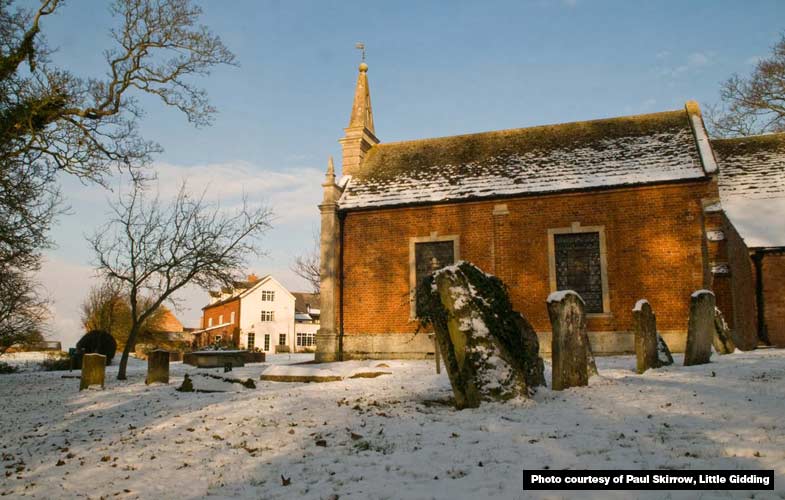
(The photograph is of Little Gidding Church and the Ferrar House in winter.)

I went to church on Advent I - I had a real longing to be there - to a parish I used to go to for Morning and Evening Prayer (one of the few around here that offer at least one of these every day).  And the priests - and some parishioners - remembered me, and greeted me kindly and warmly; I had forgotten that could happen.

It's a more-or-less Anglo-Catholic parish.  A real one, that is - no ostentation about it, but a place where the real faith is preached - and that is the central purpose.  No incense - but a small crucifix on the wall, and the unaltered words from the BCP during the rite.  I had forgotten that was possible, too.  Maybe there's a place for me, after all;  a Little Gidding in the middle of all the "bitter conflict."  I certainly could use the spiritual help....

Monday, November 26, 2012

Step 11: "Beyond question"

This was in my Facebook feed this morning, from the "Twelve Steps and Twelve Traditions" group:
"In A.A. we have found that the actual good results of prayer are beyond question. They are matters of knowledge and experience. All those who have persisted have found strength not ordinarily their own. They have found wisdom beyond their usual capability. And they have increasingly found a peace of mind which can stand firm in the face of difficult circumstances." Step 11 pg 104.
My bolding above.  This is exactly what I love about A.A.; it consists almost entirely of empirical reports back from the front.   It's people talking to people about "what works."  It's actually concrete confirmation of what religion has been up to for centuries and millennia, but seems to forget so often.

I forget it, too; I forget that prayer is good for me, and I forget to do it - often until my mind becomes completely squirrelly.  And this, after 29 years of sobriety!   Maybe it's because it's been so long, actually; I just assume that I'm completely well - but I'm not.  I need to live a day at a time, and prayer, as much as anybody else.  (I've actually heard people report in meetings that at about this time in sobriety, they completely lost it - and some have started drinking again.  That hasn't been much of a temptation for me - it never was, after I stopped, because it was all such a bad time - but I remembered again that little aphorism that "living inside my own head is spending time in a really bad neighborhood.")


Here's part of Step 11, "Sought through prayer and meditation to improve our conscious contact with God as we understood Him, praying only for knowledge of His will for us, and the power to carry that out."  My bolding.
We A.A.'s are active folk, enjoying the satisfactions of dealing with the realities of life, usually for the first time in our lives, and strenuously trying to help the next alcoholic who comes along. So it isn't surprising that we often tend to slight serious meditation and prayer as something not really necessary. To be sure, we feel it is something that might help us to meet an occasional emergency, but at first many of us are apt to regard it as a somewhat mysterious skill of clergymen, from which we may hope to get a secondhand benefit. Or perhaps we don't believe in these things at all.

To certain newcomers and to those one-time agnostics who still cling to the A.A. group as their higher power, claims for the power of prayer may, despite all the logic and experience in proof of it, still be unconvincing or quite objectionable. Those of us who once felt this way can certainly understand and sympathize. We well remember how something deep inside us kept rebelling against the idea of bowing before any God. Many of us had strong logic, too, which "proved" there was no God whatever. What about all the accidents, sickness, cruelty, and injustice in the world? What about all those unhappy lives which were the direct result of unfortunate birth and uncontrollable circumstances? Surely there could be no justice in this scheme of things, and therefore no God at all.

Sometimes we took a slightly different tack. Sure, we said to ourselves, the hen probably did come before the egg. No doubt the universe had a "first cause" of some sort, the God of the Atom, maybe, hot and cold by turns. But certainly there wasn't any evidence of a God who knew or cared about human beings. We liked A.A. all right, and were quick to say that it had done miracles. But we recoiled from meditation and prayer as obstinately as the scientist who refused to perform a certain experiment lest it prove his pet theory wrong. Of course we finally did experiment, and when unexpected results followed, we felt different; in fact we knew different; and so we were sold on meditation and prayer. And that, we have found, can happen to anybody who tries. It has been well said that "almost the only scoffers at prayer are those who never tried it enough."

Those of us who have come to make regular use of prayer would no more do without it than we would refuse air, food, or sunshine. And for the same reason. When we refuse air, light, or food, the body suffers. And when we turn away from meditation and prayer, we likewise deprive our minds, our emotions, and our intuitions of vitally needed support. As the body can fail its purpose for lack of nourishment, so can the soul. We all need the light of God's reality, the nourishment of His strength, and the atmosphere of His grace. To an amazing extent the facts of A.A. Life confirm this ageless truth.


There is a direct linkage among self-examination, meditation, and prayer. Taken separately, these practices can bring much relief and benefit. But when they are logically related and interwoven, the result is an unshakable foundation for life. Now and then we may be granted a glimpse of that ultimate reality which is God's kingdom. And we will be comforted and assured that our own destiny in that realm will be secure for so long as we try, however falteringly, to find and do the will of our own Creator.

It's good to remember all that again - I hope I don't forget again! - and notice how the text states that it's confirming something, rather than coming up with something new.

More on this later.....

Monday, June 18, 2012

More about "ego deflation at depth"

First, a correction: A.A., as an organization/entity, does not, it seems, itself use the phrase "ego deflation at depth" in any of its official literature.   That phrase was apparently used by Bill Wilson in a talk he gave before the New York City Medical Society on Alcoholism in 1958 - and he was referring, specifically, to the initial approach to the still-drinking alcoholic.

Here's the quote itself; Wilson's talking about an alcoholic patient of Carl Jung's - a man who had tried for many years to stop drink but had found it impossible.  (My bolding below.)
In substances, Dr. Jung said, "For some time after you came here, I continued to believe that you might be one of those rare cases who could make a recovery. But, I must now frankly admit that I have never seen a single case recover through the psychiatric art where the neurosis is so severe as yours. Medicine has done all that it can for you, and that’s where you stand.

Mr. R.’s depression deepened. He asked: "is there no exception; is this really the end of the line for me?"

"Well," replied the doctor, "There are some exceptions, a very few. Here and there, once in a while, alcoholics have had what are called vital spiritual experiences. They appear to be in the nature of huge emotional displacements and rearrangements. Ideas, emotions and attitudes which were once the guiding forces of these men are suddenly cast to one side, and a completely new set of conceptions and motives begin to dominate them. In fact, I have been trying to produce some such emotional rearrangement within you. With many types of neurotics, the methods which I employ are successful, but I have never been successful with an alcoholic of your description."

"But," protested the patient, "I’m a religious man, and I still have faith." To this Dr. Jung replied, "Ordinary religious faith isn’t enough. What I’m talking about is a transforming experience, a conversion experience, if you like. I can only recommend that you place yourself in the religious atmosphere of your own choice, that you recognize your personal hopelessness, and that you cast yourself upon whatever God you think there is. The lightening of the transforming experience may then strike you. This you must try- it is your only way out." So spoke a great and humble physician.

For the AA-to- be, this was a ten-strike. Science had pronounced Mr. R. virtually hopeless. Dr. Jung ‘ s words had struck him at great depth, producing an immense deflation of his ego. Deflation at depth is today a cornerstone principle of AA. There in Dr. Jung’s office it was first employed in our behalf.
(The Jung story is also found in Chapter 2 of the book Alcoholics Anonymous (PDF), AKA "The Big Book," originally published in 1939.  To my way of thinking, it's not really the discussion of a "transforming experience, a conversion experience" that's doing the work here; it's the simple, short statement at the end:  "It is your only way out," that does the job.)

Other sources say that William James is the one who first used the phrase - but I haven't found a citation to that effect.  In any case, the phrase is well-known in A.A. circles; it's very much part of the oral tradition.

And, of course, A.A.'s literature does say, in the book Twelve Steps and Twelve Traditions, that:

Step Three calls for affirmative action, for it is only by action that we can cut away the self-will which has always blocked the entry of God into our lives.
 And you'll find this passage (my bolding below) in this PDF copy of Chapter Five of the book Alcoholics Anonymous:

Our description of the alcoholic, the chapter to the agnostic, and our personal adventures before and after make clear three pertinent ideas:

a)  That we were alcoholic and could not manage our own lives.
b)  That probably no human power could have relieved our alcoholism.
c)  That God could and would if He were sought.

Being convinced, we were at Step Three, which is that we decided to turn our will and our life over to God as we understood Him. Just what do we mean by that, and just what do we do?

The first requirement is that we be convinced that any life run on self-will can hardly be a success. On that basis we are almost always in collision with something or somebody, even though our motives are good. Most people try to live by self-propulsion. Each person is like an actor who wants to run the whole show; is forever trying to arrange the lights, the ballet, the scenery and the rest of the players in his own way. If his arrangements would only stay put, if only people would do as he wished, the show would be great. Everybody, including himself, would be pleased. Life would be wonderful. In trying to make these arrangements our actor may sometimes be quite virtuous. He may be kind, considerate, patient, generous; even modest and self- sacrificing. On the other hand, he may be mean, egotistical, selfish and dishonest. But, as with most humans, he is more likely to have varied traits.

What usually happens? The show doesn't come off very well. He begins to think life doesn't treat him right. He decides to exert himself more. He becomes, on the next occasion, still more demanding or gracious, as the case may be. Still the play does not suit him. Admitting he may be somewhat at fault, he is sure that other people are more to blame. He becomes angry, indignant, self-pitying. What is his basic trouble? Is he not really a self-seeker even when trying to be kind? Is he not a victim of the delusion that he can wrest satisfaction and happiness out of this world if he only manages well? Is it not evident to all the rest of the players that these are the things he wants? And do not his actions make each of them wish to retaliate, snatching all they can get out of the show? Is he not, even in his best moments, a producer of confusion rather than harmony?

Our actor is self-centered — ego-centric, as people like to call it nowadays. He is like the retired business man who lolls in the Florida sunshine in the winter complaining of the sad state of the nation; the minister who sighs over the sins of the twentieth century; politicians and reformers who are sure all would be Utopia if the rest of the world would only behave; the outlaw safe cracker who thinks society has wronged him; and the alcoholic who has lost all and is locked up. Whatever our protestations, are not most of us concerned with ourselves, our resentments, or our self-pity?

Selfishness — self-centeredness! That, we think, is the root of our troubles. Driven by a hundred forms of fear, self-delusion, self-seeking, and self-pity, we step on the toes of our fellows and they retaliate. Sometimes they hurt us, seemingly without provocation, but we invariably find that at some time in the past we have made decisions based on self which later placed us in a position to be hurt.

So our troubles, we think, are basically of our own making. They arise out of ourselves, and the alcoholic is an extreme example of self-will run riot, though he usually doesn't think so. Above everything, we alcoholics must be rid of this selfishness. We must, or it kill us! God makes that possible. And there often seems no way of entirely getting rid of self without His aid. Many of us had moral and philosophical convictions galore, but we could not live up to them even though we would have liked to. Neither could we reduce our self-centeredness much by wishing or trying on our own power. We had to have God's help.

This is the how and the why of it. First of all, we had to quit playing God. It didn't work. Next, we decided that hereafter in this drama of life, God was going to be our Director. He is the Principal; we are His agents. He is the Father, and we are His children. Most Good ideas are simple, and this concept was the keystone of the new and triumphant arch through which we passed to freedom. When we sincerely took such a position, all sorts of remarkable things followed. We had a new Employer. Being all powerful, He provided what we needed, if we kept close to Him and performed His work well. Established on such a footing we became less and less interested in ourselves, our own little plans and designs. More and more we became interested in seeing what we could contribute to life. As we felt new power flow in, as we enjoyed peace of mind, as we discovered we could face life successfully, as we became conscious of His presence, we began to lose our fear of today, tomorrow or the hereafter. We were reborn.

We were now at Step Three. Many of us said to our Maker, as we Understood Him: "God, I offer myself to Thee — to build with me and to do with me as Thou wilt. Relieve me of the bondage of self, that I may better do Thy will. Take away my difficulties, that victory over them may bear witness to those I would help of Thy Power, Thy Love, and Thy Way of life. May I do Thy will always!" We thought well before taking this step making sure we were ready; that we could at last abandon ourselves utterly to Him.”
 
So "ego deflation" - i.e., "the cutting away of self-will," at least, really is the entire A.A. project - even if the "at depth" part referred originally to the initial effort to break down the alcoholic's resistance utterly. 

Anyway:  I'm finding it very interesting to keep in mind, too, the way James Alison describes "the two approaches to desire" in his "Prayer: a case study in mimetic anthropology"  (again, with my emphases below):
First the folk-psychology approach, which I sometimes characterise as the “blob and arrow” understanding of desire. In this approach, there is a blob located somewhere within each one of us and normally referred to as a “self”. This more or less bloated entity is pretty stable, and there come forth from it arrows which aim at objects. So, “I” desire a car, a mate, a house, a holiday, some particular clothes and so on and so forth. The desire for the object comes from the “I” which originates it, and thus the desire is authentically and truly “mine”. If I desire the same thing as someone else this is either accidental and we must be rational about resolving any conflict which may arise, or it is a result of the other person imitating my desire, which is of course stronger and more authentic than their secondary and less worthy desire. Since my desiring self, my “I”, is basically rational, it follows that my desires are basically rational, and thus that I am unlike those people who I observe to have a clearly pathological pattern of desire – constantly falling for an unsuitable type of potential mate and banging their head against the consequences, or hooked on substances or patterns of behaviour that do them no good. Those people are in some way sick, and their desires escape the possibilities of rational discourse. Unlike me and my desires.

....

The understanding of desire which Girard has been putting forward for almost half a century, and which is often referred to as “mimetic” is about as far removed from this picture as you can get. The key phrase which I never tire of repeating is “We desire according to the desire of the other”. It is the social other, the social world which surrounds us, which moves us to desire, to want, and to act. This doesn’t sound particularly challenging when it is illustrated in the way the entertainment industry creates celebrities, or the advertising profession manages to make particular objects or brands desirable. For few of us are so grandiose as to deny that some of our desires show us as being easily led and susceptible to suggestion. It becomes much more challenging when it is claimed that in fact it is not some of our desires that are being talked about, but the whole way in which we humans are structured by desire.

For what Girard is pointing out is that humans are those animals in which even basic biological instincts (which of course exist, and are not the same thing as desire) are run by the social other within which the instinct-bearing body is born. In fact, our capacity to receive and deal with our instincts is given to us through our being drawn towards the social other which inducts us into living as this sort of animal, by reproducing itself within us. And what makes this draw possible is the hugely developed capacity for imitation which sets our species apart from our nearest simian relatives.

What both A.A. and James Alison/Rene Girard are pointing to is the effort to get the ego - otherwise known, in the Alison/Girard view, as the "the social other" that runs its desires - to let go of its stranglehold on our hearts, minds, and lives.   You can approach the problem from either direction, IOW - and the key to it seems to point to exactly the same idea.

And both, BTW, point to prayer as a vitally important key to and part of the process; at the heart of both approaches is the idea of beginning to listen to, as James Alison puts it, "another Other," and to 'allow the One who knows what is good for us, unlike we ourselves, whose desire is for us and for our fruition, unlike the social other and its violent traps, to gain access to re-creating us from within, to giving us a “self”, an “I of desire” that is in fact a constant flow of treasure.'  (Liturgists like Derek will agree with this, too, I'm sure; I think he'd argue that this is exactly what liturgy does.  It gives the  "other Other" voice, via liturgical poetry, music, texts, scripts, actions, and concepts - and frequent repetition of all of the above.)

And again, I argue:  that's what the church is for.  Because what human being doesn't, in his heart, long to truly live - and while she's at it, to find access to "a constant flow treasure," consolation in distress - and a blessed release from fear and all crippling negativity?

More about "ego deflation at depth"

First, a correction: A.A., as an organization/entity, does not, it seems, itself use the phrase "ego deflation at depth" in any of its official literature.   That phrase was apparently used by Bill Wilson in a talk he gave before the New York City Medical Society on Alcoholism in 1958 - and he was referring, specifically, to the initial approach to the still-drinking alcoholic.

Here's the quote itself; Wilson's talking about an alcoholic patient of Carl Jung's - a man who had tried for many years to stop drink but had found it impossible.  (My bolding below.)
In substances, Dr. Jung said, "For some time after you came here, I continued to believe that you might be one of those rare cases who could make a recovery. But, I must now frankly admit that I have never seen a single case recover through the psychiatric art where the neurosis is so severe as yours. Medicine has done all that it can for you, and that’s where you stand.

Mr. R.’s depression deepened. He asked: "is there no exception; is this really the end of the line for me?"

"Well," replied the doctor, "There are some exceptions, a very few. Here and there, once in a while, alcoholics have had what are called vital spiritual experiences. They appear to be in the nature of huge emotional displacements and rearrangements. Ideas, emotions and attitudes which were once the guiding forces of these men are suddenly cast to one side, and a completely new set of conceptions and motives begin to dominate them. In fact, I have been trying to produce some such emotional rearrangement within you. With many types of neurotics, the methods which I employ are successful, but I have never been successful with an alcoholic of your description."

"But," protested the patient, "I’m a religious man, and I still have faith." To this Dr. Jung replied, "Ordinary religious faith isn’t enough. What I’m talking about is a transforming experience, a conversion experience, if you like. I can only recommend that you place yourself in the religious atmosphere of your own choice, that you recognize your personal hopelessness, and that you cast yourself upon whatever God you think there is. The lightening of the transforming experience may then strike you. This you must try- it is your only way out." So spoke a great and humble physician.

For the AA-to- be, this was a ten-strike. Science had pronounced Mr. R. virtually hopeless. Dr. Jung ‘ s words had struck him at great depth, producing an immense deflation of his ego. Deflation at depth is today a cornerstone principle of AA. There in Dr. Jung’s office it was first employed in our behalf.
(The Jung story is also found in Chapter 2 of the book Alcoholics Anonymous (PDF), AKA "The Big Book," originally published in 1939.  To my way of thinking, it's not really the discussion of a "transforming experience, a conversion experience" that's doing the work here; it's the simple, short statement at the end:  "It is your only way out," that does the job.)

Other sources say that William James is the one who first used the phrase - but I haven't found a citation to that effect.  In any case, the phrase is well-known in A.A. circles; it's very much part of the oral tradition.

And, of course, A.A.'s literature does say, in the book Twelve Steps and Twelve Traditions, that:

Step Three calls for affirmative action, for it is only by action that we can cut away the self-will which has always blocked the entry of God into our lives.
 And you'll find this passage (my bolding below) in this PDF copy of Chapter Five of the book Alcoholics Anonymous:

Our description of the alcoholic, the chapter to the agnostic, and our personal adventures before and after make clear three pertinent ideas:

a)  That we were alcoholic and could not manage our own lives.
b)  That probably no human power could have relieved our alcoholism.
c)  That God could and would if He were sought.

Being convinced, we were at Step Three, which is that we decided to turn our will and our life over to God as we understood Him. Just what do we mean by that, and just what do we do?

The first requirement is that we be convinced that any life run on self-will can hardly be a success. On that basis we are almost always in collision with something or somebody, even though our motives are good. Most people try to live by self-propulsion. Each person is like an actor who wants to run the whole show; is forever trying to arrange the lights, the ballet, the scenery and the rest of the players in his own way. If his arrangements would only stay put, if only people would do as he wished, the show would be great. Everybody, including himself, would be pleased. Life would be wonderful. In trying to make these arrangements our actor may sometimes be quite virtuous. He may be kind, considerate, patient, generous; even modest and self- sacrificing. On the other hand, he may be mean, egotistical, selfish and dishonest. But, as with most humans, he is more likely to have varied traits.

What usually happens? The show doesn't come off very well. He begins to think life doesn't treat him right. He decides to exert himself more. He becomes, on the next occasion, still more demanding or gracious, as the case may be. Still the play does not suit him. Admitting he may be somewhat at fault, he is sure that other people are more to blame. He becomes angry, indignant, self-pitying. What is his basic trouble? Is he not really a self-seeker even when trying to be kind? Is he not a victim of the delusion that he can wrest satisfaction and happiness out of this world if he only manages well? Is it not evident to all the rest of the players that these are the things he wants? And do not his actions make each of them wish to retaliate, snatching all they can get out of the show? Is he not, even in his best moments, a producer of confusion rather than harmony?

Our actor is self-centered — ego-centric, as people like to call it nowadays. He is like the retired business man who lolls in the Florida sunshine in the winter complaining of the sad state of the nation; the minister who sighs over the sins of the twentieth century; politicians and reformers who are sure all would be Utopia if the rest of the world would only behave; the outlaw safe cracker who thinks society has wronged him; and the alcoholic who has lost all and is locked up. Whatever our protestations, are not most of us concerned with ourselves, our resentments, or our self-pity?

Selfishness — self-centeredness! That, we think, is the root of our troubles. Driven by a hundred forms of fear, self-delusion, self-seeking, and self-pity, we step on the toes of our fellows and they retaliate. Sometimes they hurt us, seemingly without provocation, but we invariably find that at some time in the past we have made decisions based on self which later placed us in a position to be hurt.

So our troubles, we think, are basically of our own making. They arise out of ourselves, and the alcoholic is an extreme example of self-will run riot, though he usually doesn't think so. Above everything, we alcoholics must be rid of this selfishness. We must, or it kill us! God makes that possible. And there often seems no way of entirely getting rid of self without His aid. Many of us had moral and philosophical convictions galore, but we could not live up to them even though we would have liked to. Neither could we reduce our self-centeredness much by wishing or trying on our own power. We had to have God's help.

This is the how and the why of it. First of all, we had to quit playing God. It didn't work. Next, we decided that hereafter in this drama of life, God was going to be our Director. He is the Principal; we are His agents. He is the Father, and we are His children. Most Good ideas are simple, and this concept was the keystone of the new and triumphant arch through which we passed to freedom. When we sincerely took such a position, all sorts of remarkable things followed. We had a new Employer. Being all powerful, He provided what we needed, if we kept close to Him and performed His work well. Established on such a footing we became less and less interested in ourselves, our own little plans and designs. More and more we became interested in seeing what we could contribute to life. As we felt new power flow in, as we enjoyed peace of mind, as we discovered we could face life successfully, as we became conscious of His presence, we began to lose our fear of today, tomorrow or the hereafter. We were reborn.

We were now at Step Three. Many of us said to our Maker, as we Understood Him: "God, I offer myself to Thee — to build with me and to do with me as Thou wilt. Relieve me of the bondage of self, that I may better do Thy will. Take away my difficulties, that victory over them may bear witness to those I would help of Thy Power, Thy Love, and Thy Way of life. May I do Thy will always!" We thought well before taking this step making sure we were ready; that we could at last abandon ourselves utterly to Him.”
 
So "ego deflation" - i.e., "the cutting away of self-will," at least, really is the entire A.A. project - even if the "at depth" part referred originally to the initial effort to break down the alcoholic's resistance utterly. 

Anyway:  I'm finding it very interesting to keep in mind, too, the way James Alison describes "the two approaches to desire" in his "Prayer: a case study in mimetic anthropology"  (again, with my emphases below):
First the folk-psychology approach, which I sometimes characterise as the “blob and arrow” understanding of desire. In this approach, there is a blob located somewhere within each one of us and normally referred to as a “self”. This more or less bloated entity is pretty stable, and there come forth from it arrows which aim at objects. So, “I” desire a car, a mate, a house, a holiday, some particular clothes and so on and so forth. The desire for the object comes from the “I” which originates it, and thus the desire is authentically and truly “mine”. If I desire the same thing as someone else this is either accidental and we must be rational about resolving any conflict which may arise, or it is a result of the other person imitating my desire, which is of course stronger and more authentic than their secondary and less worthy desire. Since my desiring self, my “I”, is basically rational, it follows that my desires are basically rational, and thus that I am unlike those people who I observe to have a clearly pathological pattern of desire – constantly falling for an unsuitable type of potential mate and banging their head against the consequences, or hooked on substances or patterns of behaviour that do them no good. Those people are in some way sick, and their desires escape the possibilities of rational discourse. Unlike me and my desires.

....

The understanding of desire which Girard has been putting forward for almost half a century, and which is often referred to as “mimetic” is about as far removed from this picture as you can get. The key phrase which I never tire of repeating is “We desire according to the desire of the other”. It is the social other, the social world which surrounds us, which moves us to desire, to want, and to act. This doesn’t sound particularly challenging when it is illustrated in the way the entertainment industry creates celebrities, or the advertising profession manages to make particular objects or brands desirable. For few of us are so grandiose as to deny that some of our desires show us as being easily led and susceptible to suggestion. It becomes much more challenging when it is claimed that in fact it is not some of our desires that are being talked about, but the whole way in which we humans are structured by desire.

For what Girard is pointing out is that humans are those animals in which even basic biological instincts (which of course exist, and are not the same thing as desire) are run by the social other within which the instinct-bearing body is born. In fact, our capacity to receive and deal with our instincts is given to us through our being drawn towards the social other which inducts us into living as this sort of animal, by reproducing itself within us. And what makes this draw possible is the hugely developed capacity for imitation which sets our species apart from our nearest simian relatives.

What both A.A. and James Alison/Rene Girard are pointing to is the effort to get the ego - otherwise known, in the Alison/Girard view, as the "the social other" that runs its desires - to let go of its stranglehold on our hearts, minds, and lives.   You can approach the problem from either direction, IOW - and the key to it seems to point to exactly the same idea.

And both, BTW, point to prayer as a vitally important key to and part of the process; at the heart of both approaches is the idea of beginning to listen to, as James Alison puts it, "another Other," and to 'allow the One who knows what is good for us, unlike we ourselves, whose desire is for us and for our fruition, unlike the social other and its violent traps, to gain access to re-creating us from within, to giving us a “self”, an “I of desire” that is in fact a constant flow of treasure.'  (Liturgists like Derek will agree with this, too, I'm sure; I think he'd argue that this is exactly what liturgy does.  It gives the  "other Other" voice, via liturgical poetry, music, texts, scripts, actions, and concepts - and frequent repetition of all of the above.)

And again, I argue:  that's what the church is for.  Because what human being doesn't, in his heart, long to truly live - and while she's at it, to find access to "a constant flow treasure," consolation in distress - and a blessed release from fear and all crippling negativity?

Monday, May 7, 2012

James Alison: "Prayer: a case study in mimetic anthropology"

From his website, a look at some texts on prayer from Matthew's gospel, read "in the light of" René Girard’s mimetic theory, and contrasted with "a reading which depends on a folk-psychology approach to desire."  (All bolding below by me.)

So, a brief reminder of each of these two approaches. First the folk-psychology approach, which I sometimes characterise as the “blob and arrow” understanding of desire. In this approach, there is a blob located somewhere within each one of us and normally referred to as a “self”. This more or less bloated entity is pretty stable, and there come forth from it arrows which aim at objects. So, “I” desire a car, a mate, a house, a holiday, some particular clothes and so on and so forth. The desire for the object comes from the “I” which originates it, and thus the desire is authentically and truly “mine”. If I desire the same thing as someone else this is either accidental and we must be rational about resolving any conflict which may arise, or it is a result of the other person imitating my desire, which is of course stronger and more authentic than their secondary and less worthy desire. Since my desiring self, my “I”, is basically rational, it follows that my desires are basically rational, and thus that I am unlike those people who I observe to have a clearly pathological pattern of desire – constantly falling for an unsuitable type of potential mate and banging their head against the consequences, or hooked on substances or patterns of behaviour that do them no good. Those people are in some way sick, and their desires escape the possibilities of rational discourse. Unlike me and my desires.

If this is an accurate understanding of how we desire, then of course the New Testament is weirdly quaint and inaccurate, for all it would be doing when talking about prayer is urging us to whip ourselves (and how can “we” whip our “selves”?) into wanting more. Furthermore, following this view the New Testament would contain within itself the seeds of the destruction of its own teaching about prayer, for in the text from St Matthew’s Gospel at which we will be looking in more detail, there appears the phrase

When you are praying, do not heap up empty phrases as the Gentiles do; for they think that they will be heard because of their many words. Do not be like them, for your Father knows what you need before you ask him.

The logical conclusion to this, given the premise of the blob and arrow understanding of desire, is to stop praying. There is literally no point expressing your desire, since it is known independently of its expression, and its expression makes no difference at all. The New Testament text seems to be a pointer on the road towards the self-contained and religiously indifferent modern “self”.

Please notice also that since desires are arrived at by the self without need of instruction or intervention from outside and don’t need to be expressed in order to be real, the self-contained and self-starting “blob” with its arrows is also radically private. ... And please notice how miraculously the New Testament text, once again doing itself out of a job, seems to flatter this picture of the self. For if there is one verse from this section of Matthew that almost everyone seems to remember it is where Jesus, having disparaged the attention-seeking public prayers of the Pharisees says this:

But whenever you pray, go into your room and shut the door and pray to your Father who is in secret; and your Father who sees in secret will reward you.

Behold the apparent Scriptural canonisation of the modern individual self (who is, of course, “spiritual”, but not “religious”)!
Then Alison explains the Girardian take on desire:
The understanding of desire which Girard has been putting forward for almost half a century, and which is often referred to as “mimetic” is about as far removed from this picture as you can get. The key phrase which I never tire of repeating is “We desire according to the desire of the other”. It is the social other, the social world which surrounds us, which moves us to desire, to want, and to act. This doesn’t sound particularly challenging when it is illustrated in the way the entertainment industry creates celebrities, or the advertising profession manages to make particular objects or brands desirable. For few of us are so grandiose as to deny that some of our desires show us as being easily led and susceptible to suggestion. It becomes much more challenging when it is claimed that in fact it is not some of our desires that are being talked about, but the whole way in which we humans are structured by desire.

For what Girard is pointing out is that humans are those animals in which even basic biological instincts (which of course exist, and are not the same thing as desire) are run by the social other within which the instinct-bearing body is born. In fact, our capacity to receive and deal with our instincts is given to us through our being drawn towards the social other which inducts us into living as this sort of animal, by reproducing itself within us. And what makes this draw possible is the hugely developed capacity for imitation which sets our species apart from our nearest simian relatives.


And the way this plays out in reading Matthew 6, and in the discussion of what prayer actually is - well, it's fantastic! 
Given this, let us turn to Jesus’ explicit teaching about prayer, especially as we find it in Matthew 6, but with some reference to Luke also.

The first thing we notice is that Jesus’ comments on prayer are embedded in a teaching about patterns of desire.
“Beware of practicing your piety before others in order to be seen by them; for then you have no reward from your Father in heaven. So whenever you give alms, do not sound a trumpet before you, as the hypocrites do in the synagogues and in the streets, so that they may be praised by others. Truly I tell you, they have received their reward. But when you give alms, do not let your left hand know what your right hand is doing, so that your alms may be done in secret; and your Father who sees in secret will reward you.” [5] (Italics mine)
Before he gets to talking about prayer, Jesus is already demonstrating an understanding of desire. His presupposition is that we are all immensely needy people who long for approval and rewards. He doesn’t say “Really, this is too infantile. You shouldn’t be wanting approval or rewards. Grow up and be self-starting, self-contained heroic individuals who act on entirely rational grounds”. On the contrary, he takes it for granted that we desperately need approval. The question is: whose approval is going to run us? The danger of seeking approval from the social other is that you will get it, and thereafter you will be hooked on that approval. It will literally give you to be who you are and what you will become. You will act out of the pattern of desire which the social other gives you.

I used to think that the phrase “Truly I tell you, they have received their reward”, especially when pronounced in booming tones by a Scots-accented Calvinist preacher, was a euphemism for sending someone to Hell. But it makes much more sense if you see it as an anthropological observation: the trouble about seeking the approval of the social other, is that you will get it. You will act in such a way as to get that approval, and then become its puppet. And because of that you will be selling yourself short. You won’t be wanting enough, you will have too little desire. Your “self” will be a shadow of what you could be if you allowed the Creator to call you into being.
The article is long, and difficult to summarize; it's densely packed with ideas and images, too, and it illuminates - almost shockingly - the text in a way I haven't seen done before. It's theologically rich and - how can I say this? - detoxifying of the puritanism Alison talks about in the article. He defines that puritansim as the psychological result of suppression (not sublimation) of desire.

And because the article is so complex, and requires the bit of introduction I've given above, I can only bullet-point the many, many ideas discussed and conclusions drawn about prayer, and about what it's for, and about how it works! Here are some of those ideas and conclusions (keeping in mind that there is much more at the link!):
  • How the suppression of authentic desire in the effort to obtain approval works itself out in us psychologically; 
  • Jesus 'urging his disciples to receive their “self” from “Another other” (and the Matthean code for “Another other” is “your Father who sees in secret” or “your Father who is in heaven” – that is, the Creator who is absolutely not part of the give and take, the tit-for-tat reciprocity of the social other)'; 
  • That, because there is "no alternative to being run by the regard of another" (i.e., "It is not the case that we can strip off the false-selves given us by the social other, and that there, underneath it all, radiantly, will be our true self, untrammeled by the social other."), the "really hard matter of prayer is learning to receive ourselves through the eye of Another other." 
  • That this "eye of Another" is God's eye - and being in God's "regard" means "looked at by One who is not part of" the mimetic system at all.  It's described as being seen by an Eye that's defined by "deathlessness, abundance, daring, and [the defining principle of bringing] something out of nothing."
  • That Jesus teaches not that prayer is an appeal to a God who's an object who must be manipulated, but precisely the opposite:  "....it is God who is the subject, who has a desire, an intention, a longing, and who knows who we are and what is good for us and we who are capricious and somewhat inert slot machines who are always getting our handles pulled by the wrong players. In this picture it is precisely because our Father knows what we need before we ask him that we must learn to pray: our Father’s only access to us, the only way he can get to our slot-machine handle, is by our asking him into our pattern of desire";
  • Thus, the "urgent reason why we need to pray: so as to allow the One who knows what is good for us, unlike we ourselves, whose desire is for us and for our fruition, unlike the social other and its violent traps, to gain access to re-creating us from within, to giving us a “self”, an “I of desire” that is in fact a constant flow of treasure.  We are asking, in fact to become a symptom of his pattern of desire, rather than that of the social other which ties us up into becoming so much less."
You can see, I'm sure, what's being said here:  that we have no way to extricate ourselves from the destructive influence of the "social other" and its "patterns of desire" - except through prayer, which is a vehicle that allows God access to us (and not, as I think most of us have always assumed, the other way around!). 

Probably I should have written this post in a different way. It feels like I'm shortchanging these ideas - so I hope you'll go read the article yourself. It's well worth the time it takes to slowly sift through and absorb what he's saying.

Alison talks a lot about how Girard's ideas seem eerily applicable to the Bible as a whole; he's said (paraphrasing) that you can "throw the texts up and let them come down any which way" and the analysis seems to work every time.

And he says here, at the start of this article: "I suspect that we are here in the presence of what René Girard refers to in The Scapegoat when he talks about the texts of the New Testament bearing witness to an intelligence greater than that of each of the (admittedly highly sophisticated) members of the apostolic circle who composed them. Ockham’s razor would suggest that this is an intelligence that goes back to Our Lord himself."

Which is a spookily awesome thought, really....

James Alison: "Prayer: a case study in mimetic anthropology"

From his website, a look at some texts on prayer from Matthew's gospel, read "in the light of" René Girard’s mimetic theory, and contrasted with "a reading which depends on a folk-psychology approach to desire."  (All bolding below by me.)

So, a brief reminder of each of these two approaches. First the folk-psychology approach, which I sometimes characterise as the “blob and arrow” understanding of desire. In this approach, there is a blob located somewhere within each one of us and normally referred to as a “self”. This more or less bloated entity is pretty stable, and there come forth from it arrows which aim at objects. So, “I” desire a car, a mate, a house, a holiday, some particular clothes and so on and so forth. The desire for the object comes from the “I” which originates it, and thus the desire is authentically and truly “mine”. If I desire the same thing as someone else this is either accidental and we must be rational about resolving any conflict which may arise, or it is a result of the other person imitating my desire, which is of course stronger and more authentic than their secondary and less worthy desire. Since my desiring self, my “I”, is basically rational, it follows that my desires are basically rational, and thus that I am unlike those people who I observe to have a clearly pathological pattern of desire – constantly falling for an unsuitable type of potential mate and banging their head against the consequences, or hooked on substances or patterns of behaviour that do them no good. Those people are in some way sick, and their desires escape the possibilities of rational discourse. Unlike me and my desires.

If this is an accurate understanding of how we desire, then of course the New Testament is weirdly quaint and inaccurate, for all it would be doing when talking about prayer is urging us to whip ourselves (and how can “we” whip our “selves”?) into wanting more. Furthermore, following this view the New Testament would contain within itself the seeds of the destruction of its own teaching about prayer, for in the text from St Matthew’s Gospel at which we will be looking in more detail, there appears the phrase

When you are praying, do not heap up empty phrases as the Gentiles do; for they think that they will be heard because of their many words. Do not be like them, for your Father knows what you need before you ask him.

The logical conclusion to this, given the premise of the blob and arrow understanding of desire, is to stop praying. There is literally no point expressing your desire, since it is known independently of its expression, and its expression makes no difference at all. The New Testament text seems to be a pointer on the road towards the self-contained and religiously indifferent modern “self”.

Please notice also that since desires are arrived at by the self without need of instruction or intervention from outside and don’t need to be expressed in order to be real, the self-contained and self-starting “blob” with its arrows is also radically private. ... And please notice how miraculously the New Testament text, once again doing itself out of a job, seems to flatter this picture of the self. For if there is one verse from this section of Matthew that almost everyone seems to remember it is where Jesus, having disparaged the attention-seeking public prayers of the Pharisees says this:

But whenever you pray, go into your room and shut the door and pray to your Father who is in secret; and your Father who sees in secret will reward you.

Behold the apparent Scriptural canonisation of the modern individual self (who is, of course, “spiritual”, but not “religious”)!
Then Alison explains the Girardian take on desire:
The understanding of desire which Girard has been putting forward for almost half a century, and which is often referred to as “mimetic” is about as far removed from this picture as you can get. The key phrase which I never tire of repeating is “We desire according to the desire of the other”. It is the social other, the social world which surrounds us, which moves us to desire, to want, and to act. This doesn’t sound particularly challenging when it is illustrated in the way the entertainment industry creates celebrities, or the advertising profession manages to make particular objects or brands desirable. For few of us are so grandiose as to deny that some of our desires show us as being easily led and susceptible to suggestion. It becomes much more challenging when it is claimed that in fact it is not some of our desires that are being talked about, but the whole way in which we humans are structured by desire.

For what Girard is pointing out is that humans are those animals in which even basic biological instincts (which of course exist, and are not the same thing as desire) are run by the social other within which the instinct-bearing body is born. In fact, our capacity to receive and deal with our instincts is given to us through our being drawn towards the social other which inducts us into living as this sort of animal, by reproducing itself within us. And what makes this draw possible is the hugely developed capacity for imitation which sets our species apart from our nearest simian relatives.


And the way this plays out in reading Matthew 6, and in the discussion of what prayer actually is - well, it's fantastic! 
Given this, let us turn to Jesus’ explicit teaching about prayer, especially as we find it in Matthew 6, but with some reference to Luke also.

The first thing we notice is that Jesus’ comments on prayer are embedded in a teaching about patterns of desire.
“Beware of practicing your piety before others in order to be seen by them; for then you have no reward from your Father in heaven. So whenever you give alms, do not sound a trumpet before you, as the hypocrites do in the synagogues and in the streets, so that they may be praised by others. Truly I tell you, they have received their reward. But when you give alms, do not let your left hand know what your right hand is doing, so that your alms may be done in secret; and your Father who sees in secret will reward you.” [5] (Italics mine)
Before he gets to talking about prayer, Jesus is already demonstrating an understanding of desire. His presupposition is that we are all immensely needy people who long for approval and rewards. He doesn’t say “Really, this is too infantile. You shouldn’t be wanting approval or rewards. Grow up and be self-starting, self-contained heroic individuals who act on entirely rational grounds”. On the contrary, he takes it for granted that we desperately need approval. The question is: whose approval is going to run us? The danger of seeking approval from the social other is that you will get it, and thereafter you will be hooked on that approval. It will literally give you to be who you are and what you will become. You will act out of the pattern of desire which the social other gives you.

I used to think that the phrase “Truly I tell you, they have received their reward”, especially when pronounced in booming tones by a Scots-accented Calvinist preacher, was a euphemism for sending someone to Hell. But it makes much more sense if you see it as an anthropological observation: the trouble about seeking the approval of the social other, is that you will get it. You will act in such a way as to get that approval, and then become its puppet. And because of that you will be selling yourself short. You won’t be wanting enough, you will have too little desire. Your “self” will be a shadow of what you could be if you allowed the Creator to call you into being.
The article is long, and difficult to summarize; it's densely packed with ideas and images, too, and it illuminates - almost shockingly - the text in a way I haven't seen done before. It's theologically rich and - how can I say this? - detoxifying of the puritanism Alison talks about in the article. He defines that puritansim as the psychological result of suppression (not sublimation) of desire.

And because the article is so complex, and requires the bit of introduction I've given above, I can only bullet-point the many, many ideas discussed and conclusions drawn about prayer, and about what it's for, and about how it works! Here are some of those ideas and conclusions (keeping in mind that there is much more at the link!):
  • How the suppression of authentic desire in the effort to obtain approval works itself out in us psychologically; 
  • Jesus 'urging his disciples to receive their “self” from “Another other” (and the Matthean code for “Another other” is “your Father who sees in secret” or “your Father who is in heaven” – that is, the Creator who is absolutely not part of the give and take, the tit-for-tat reciprocity of the social other)'; 
  • That, because there is "no alternative to being run by the regard of another" (i.e., "It is not the case that we can strip off the false-selves given us by the social other, and that there, underneath it all, radiantly, will be our true self, untrammeled by the social other."), the "really hard matter of prayer is learning to receive ourselves through the eye of Another other." 
  • That this "eye of Another" is God's eye - and being in God's "regard" means "looked at by One who is not part of" the mimetic system at all.  It's described as being seen by an Eye that's defined by "deathlessness, abundance, daring, and [the defining principle of bringing] something out of nothing."
  • That Jesus teaches not that prayer is an appeal to a God who's an object who must be manipulated, but precisely the opposite:  "....it is God who is the subject, who has a desire, an intention, a longing, and who knows who we are and what is good for us and we who are capricious and somewhat inert slot machines who are always getting our handles pulled by the wrong players. In this picture it is precisely because our Father knows what we need before we ask him that we must learn to pray: our Father’s only access to us, the only way he can get to our slot-machine handle, is by our asking him into our pattern of desire";
  • Thus, the "urgent reason why we need to pray: so as to allow the One who knows what is good for us, unlike we ourselves, whose desire is for us and for our fruition, unlike the social other and its violent traps, to gain access to re-creating us from within, to giving us a “self”, an “I of desire” that is in fact a constant flow of treasure.  We are asking, in fact to become a symptom of his pattern of desire, rather than that of the social other which ties us up into becoming so much less."
You can see, I'm sure, what's being said here:  that we have no way to extricate ourselves from the destructive influence of the "social other" and its "patterns of desire" - except through prayer, which is a vehicle that allows God access to us (and not, as I think most of us have always assumed, the other way around!). 

Probably I should have written this post in a different way. It feels like I'm shortchanging these ideas - so I hope you'll go read the article yourself. It's well worth the time it takes to slowly sift through and absorb what he's saying.

Alison talks a lot about how Girard's ideas seem eerily applicable to the Bible as a whole; he's said (paraphrasing) that you can "throw the texts up and let them come down any which way" and the analysis seems to work every time.

And he says here, at the start of this article: "I suspect that we are here in the presence of what René Girard refers to in The Scapegoat when he talks about the texts of the New Testament bearing witness to an intelligence greater than that of each of the (admittedly highly sophisticated) members of the apostolic circle who composed them. Ockham’s razor would suggest that this is an intelligence that goes back to Our Lord himself."

Which is a spookily awesome thought, really....