Tuesday, March 18, 2014

Attende, Domine

This 10th-Century Mozarabic hymn, sung here by "Cantori Gregoriani, Stirps Jesse, Enrico de Capitani," is especially appropriate for Lent.


Here's the original Latin text:

Attende Domine, et miserere, quia peccavimus tibi.

Ad te Rex summe,
omnium Redemptor,
oculos nostros
sublevamus flentes:
exaudi, Christe,
supplicantum preces.

Attende Domine, et miserere, quia peccavimus tibi.

Dextera Patris,
lapis angularis,
via salutis,
ianua caelestis,
ablue nostri
maculas delicti.

Attende Domine, et miserere, quia peccavimus tibi.

Rogamus, Deus,
tuam maiestatem:
auribus sacris
gemitus exaudi:
crimina nostra
placidus indulge.

Attende Domine, et miserere, quia peccavimus tibi.

Tibi fatemur
crimina admissa:
contrito corde
pandimus occulta:
tua, Redemptor,
pietas ignoscat.

Attende Domine, et miserere, quia peccavimus tibi.

Innocens captus,
nec repugnans ductus;
testibus falsis
pro impiis damnatus
quos redemisti,
tu conserva, Christe.

Attende Domine, et miserere, quia peccavimus tibi.


The English language version of the hymn is called "The Lent Prose"; it's led here by George Curnow, Senior Cantor at the Church of St. Martin in Roath (Wales):


The words in English:
Hear us, O Lord, have mercy upon us: for we have sinned against thee.

To thee, Redeemer, on thy throne of glory:
lift we our weeping eyes in holy pleadings:
listen, O Jesu, to our supplications.

Hear us, O Lord, have mercy upon us: for we have sinned against thee.

O thou chief cornerstone, right hand of the Father:
way of salvation, gate of life celestial:
cleanse thou our sinful souls from all defilement.

Hear us, O Lord, have mercy upon us: for we have sinned against thee.

God, we implore thee, in thy glory seated:
bow down and hearken to thy weeping children:
pity and pardon all our grievous trespasses.

Hear us, O Lord, have mercy upon us: for we have sinned against thee.

Sins oft committed, now we lay before thee:
with true contrition, now no more we veil them:
grant us, Redeemer, loving absolution.

Hear us, O Lord, have mercy upon us: for we have sinned against thee.

Innocent captive, taken unresisting:
falsely accused, and for us sinners sentenced,
save us, we pray thee, Jesu, our Redeemer.

Hear us, O Lord, have mercy upon us: for we have sinned against thee.

Friday, March 14, 2014

The Lent 2 Gradual: Sciant Gentes ("Let the Gentiles know")

Sciant Gentes ("Let the Gentiles know") is the Gradual for the Second Sunday in Lent.


Gradual • Sciant Gentes Quoniam Nomen Tibi Deus from Corpus Christi Watershed on Vimeo.

The text is taken from Psalm (82/)83, vv 18, then 13; here's an English translation:
Let the Gentiles know that God is Thy Name: Thou alone art the Most High over all the earth.

Vs. O my God, make them like a wheel, and as stubble before the wind.

(Other translations have "whirling dust" or "tumbleweeds" instead of "wheel," in that  second verse!  Interesting.)


Here's the full score:


Sciant Gentes was originally, it seems, the Gradual for Septuagesima Sunday.

Here's a bit about Psalm 83:
Psalm 83 is the last of the Psalms of Asaph, which include Psalms 50 and 73-83. It is also the last of the so-called "Elohist" collection, Psalms 42-83, in which the one of God's titles, Elohim is mainly used.[1]:405[2]:7 It is generally seen as a national lament provoked by the threat of an invasion of Israel by its neighbors. The psalm has been seen by some commentators as being purely cultic in nature. Others have indicated that the fact that particular nations are specifically named indicates that it does refer to a specific historical period, even though the prayer itself would be offered in the Temple in Jerusalem.[3] The dating of the composition of the Psalm is debated, but the reference in verse 9 to Assyria is by many sources seen as an indication that the Psalm was written during the time of Assyrian ascendancy, the ninth to seventh centuries BC.[4] Others have placed the composition of the psalm between the time of Saul to the age of the Maccabees,[3] suggested by Theodore of Mopsuestia.[5]

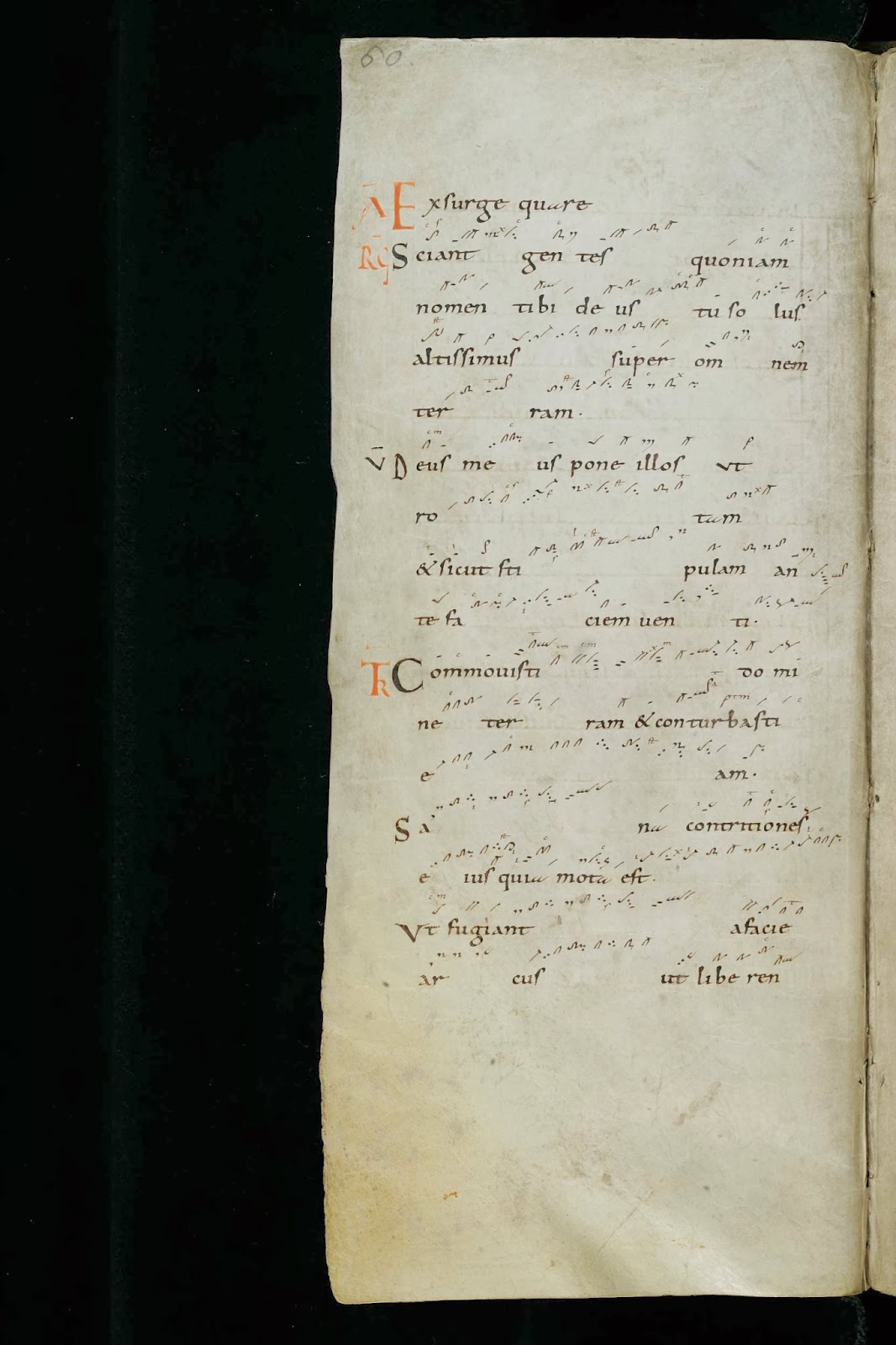
Here is a page from the Sankt-Gallen, Cantatorium, CH-SGs 359, f. 60, that includes this Gradual:


About that "St. Gall Cantatorium":
The so-called Cantatorium of St. Gall, the earliest complete extant musical manuscript in the world with neume notation. It contains the solo chants of the Mass and constitutes one of the main sources for the reconstruction of Gregorian chant. Written and provided with fine neumes in the monastery of St. Gall between 922 and 926. Bound in a wooden box with an ivory panel on the front cover, most likely Byzantine c. 500, depicting scenes from the fight of Dionysos against the Indians. The ivory panel was once the possession of Charlemagne. (smu)

You can see other images of the chant via links here, at gregorien.info.

It looks like Luigi Cherubini set this text - but it was apparently never recorded until The Kammerchor Stuttgart did it in 2013!   So, no video here.

Here are all of today's chant propers, sung by the Sao Paulo Benedictines:

Hebdomada secunda quadragesimæ
Dominica
Introitus: Ps. 26, 8.9 et 1 Tibi dixit cor meum (cum Gloria Patri) (2m59.6s - 2808 kb)
Graduale: Ps. 82, 19. V. 14 Sciant gentes (3m00.8s - 2828 kb) score
Tractus: Ps. 59, 4.6 Commovisti (2m18.1s - 2160 kb) score
Offertorium: Ps. 118, 47.48 Meditabor (1m16.1s - 1192 kb) score
Communio: Mt. 17, 9 Visionem (2m36.4s - 2446 kb) score

Here are links to Chantblog articles about some of these:

Friday, March 7, 2014

The Lent I Offertory: Scapulis suis

The Offertory on the First Sunday in Lent is Scapulis Suis ("His pinions"); it uses exactly the same text - with a different melody - as the Communion song on the day.  

Here's an mp3 of the Offertory from JoguesChant, and below is the score:


Here's their English translation:
He will overshadow you with his pinions, and you will find refuge under his wings. His faithfulness will encompass you with a shield.

Here's CCWatershed's "Simple English Propers" version; quite lovely:


All of the propers for today come from a single source:  Psalm 91 (Psalm 90 in the Vulgate reckoning), called Qui habitat.  It's certainly a wonderful text; it's a Compline Psalm as well.  Here's the US Book of Common Prayer version of the full Psalm:
Psalm 91 Qui habitat
1
He who dwells in the shelter of the Most High, * abides under the shadow of the Almighty.
2
He shall say to the LORD, "You are my refuge and my stronghold, * my God in whom I put my trust."
3
He shall deliver you from the snare of the hunter * and from the deadly pestilence.
4
He shall cover you with his pinions, and you shall find refuge under his wings; * his faithfulness shall be a shield and buckler.
5
You shall not be afraid of any terror by night, * nor of the arrow that flies by day;
6
Of the plague that stalks in the darkness, * nor of the sickness that lays waste at mid-day.
7
A thousand shall fall at your side and ten thousand at your right hand, * but it shall not come near you.
8
Your eyes have only to behold * to see the reward of the wicked.
9
Because you have made the LORD your refuge, * and the Most High your habitation,
10
There shall no evil happen to you, * neither shall any plague come near your dwelling.
11
For he shall give his angels charge over you, * to keep you in all your ways.
12
They shall bear you in their hands, * lest you dash your foot against a stone.
13
You shall tread upon the lion and the adder; * you shall trample the young lion and the serpent under your feet.
14
Because he is bound to me in love, therefore will I deliver him; * I will protect him, because he knows my Name.
15
He shall call upon me, and I will answer him; * I am with him in trouble; I will rescue him and bring him to honor.
16
With long life will I satisfy him, * and show him my salvation.
  
And here is a wonderful video of this text, sung by the Schola Hungarica.  It's labeled "Offertorium" - but it includes some other texts as well; it may be a trope, although all of the content comes straight from Psalm (90/)91.   And it's not the standard Liber Usualis melody as above - but it's definitely worth listening to!


This comes from the YouTube page:
Missa - Offertorium / Mass - The Offertory

Scapulis suis obumbrabit tibi,
et sub pennis ejus sperabis,

* scuto circumdabit te veritas ejus.
Dicet Domino: Susceptor meus es,
non timebis a timore nocturno,
a sagitta volante per diem.
* Scuto ..

V) Quoniam Angelis suis mandavit de te,
ut custodiant te in omnibus viis tuis.
* Scuto ..

V) Super aspidem et basiliscum ambulabis,
et conculcabis leonem et draconem,
quoniam in me speravit liberabo eum.

* Scuto ..

Offertory

He will cover you with his feathers,
and under his wings you will find refuge,

* His faithfulness will be Your shield and rampart
V) I will say of the Lord: He is my refuge,

You will not fear the terror of the night,
nor the arrow that flies by day,
His faithfulness will be your shield ...
For he will command his angels concerning you
to guard you in all your ways"

* His faithfulness will be your shield...

You will tread upon the lion and the cobra;
you will trample the great lion and the serpent;
for he trusts me and I will save him.

* His faithfulness will be your shield...
*********************************
Sung in Latin by the Schola Hungarica:


Looks like you can buy this mp3, and all the others from the CD, at "Old Roman Liturgical Chants: 1st Sunday Of Lent."

Here's an interesting thing about the Schola Hungarica, from Naxos:
The musicologists László Dobszay and Janka Szendrei founded the Schola Hungarica in Budapest in 1969. Concentrating their efforts on Gregorian chant, the Schola Hungarica has sung many works from late-medieval choral traditions and liturgies throughout Hungary, France, Italy, Sweden and Bohemia. In depth musicological research on the repertoire and a lively interpretive performance are the hallmarks of the ensemble. The characteristic sound of the Schola Hungarica is produced through a combination of children’s, men’s and women’s voices. Sources record that in the late Middle Ages children and adults (all male) sang in cathedral, collegiate and parish churches. The choir has made more than fifty records and compact discs, for which it received numerous international prizes. The Schola Hungarica has toured many European countries, and is one of the most recorded choral ensembles specialising in Early Music.'


Here are the propers for for Lent I, from the Brazilian Benedictines:

Hebdomada prima quadragesimæ
Dominica
Introitus: Ps. 90, 15.16 et 1 Invocabit me (cum Gloria Patri) (4m21.1s - 4083 kb) score
Graduale: Ps. 90, 11-12 Angelis suis (4m03.3s - 3805 kb) score
Tractus: Ps. 90, 1-7 et 11-16 Qui habitat (2m59.0s - 2801 kb) score
Offertorium: Ps. 90, 4-5 Scapulis suis (1m04.4s - 1011 kb) score
Communio: Ps. 90, 4-5 Scapulis suis (4m32.5s - 4261 kb) score


Here are posts on Chantblog about the propers for the First Sunday in Lent:

Tuesday, March 4, 2014

Ash Wednesday: Call to Remembrance, O Lord (Farrant)

Sung here by the Tewkesbury Abbey School Choir:


Call to remembrance, O Lord, thy tender mercies and thy loving kindness, which hath been ever of old. O remember not the sins and offences of my youth: but according to thy mercy think thou on me, O Lord, for thy goodness. (Psalm 25: 5-6)


"The people who challenged my atheism most were drug addicts and prostitutes"

From Chris Arnade, at theguardian.com:

Photograph: Chris Arnade

They prayed whenever they could find 15 minutes. "Preacher Man", as we called him, would read from the Bible with his tiny round glasses. It was the only book he had ever read. A dozen or so others would listen, silently praying while stroking rosaries, sitting on bare mattresses, crammed into a half-painted dorm room.

I was the outsider, a 16-year-old working on a summer custodial crew for a local college, saving money to pay for my escape from my hometown. The other employees, close to three dozen, were working to feed themselves, to feed their kids, to pay child support, to pay for the basics of life. I was the only white, everyone else was African-American.

Preacher Man tried to get me to join the prayer meetings, asking me almost daily. I declined, preferring to spend those small work breaks with some of the other guys on the crew. We would use the time to snatch a quick drink or maybe smoke a joint.

Preacher Man would question me, "What do you believe in?" I would decline to engage, out of politeness. He pressed me. Finally I broke,
I am an atheist. I don't believe in a God. I don't think the world is only 5,000 years old, I don't think Cain and Abel married their sisters!
Preacher Man's eyes narrowed. He pointed at me, "You are an APE-IEST. An APE-IEST. You going to lead a life of sin and end in hell."

Three years later I did escape my town, eventually receiving a PhD in physics, and then working on Wall Street for 20 years. A life devoted to rational thought, a life devoted to numbers and clever arguments.

During that time I counted myself an atheist and nodded in agreement as a wave of atheistic fervor swept out of the scientific community and into the media, led by Richard Dawkins.

I saw some of myself in him: quick with arguments, uneasy with emotions, comfortable with logic, able to look at any ideology or any thought process and expose the inconsistencies. We all picked on the Bible, a tome cobbled together over hundreds of years that provides so many inconsistencies. It is the skinny 85lb (35.6kg) weakling for anyone looking to flex their scientific muscles.

I eventually left my Wall Street job and started working with and photographing homeless addicts in the South Bronx. When I first walked into the Bronx I assumed I would find the same cynicism I had towards faith. If anyone seemed the perfect candidate for atheism it was the addicts who see daily how unfair, unjust, and evil the world can be.

None of them are. Rather they are some of the strongest believers I have met, steeped in a combination of Bible, superstition, and folklore.

The first addict I met was Takeesha. She was standing near the high wall of the Corpus Christi Monastery. We talked for close to an hour before I took her picture. When we finished, I asked her how she wanted to be described. She said without any pause, "As who I am. A prostitute, a mother of six, and a child of God."

Takeesha was raped by a relative when she was 11. Her mother, herself a prostitute, put Takeesha out on the streets at 13, where she has been for the last 30 years,
It's sad when it's your mother, who you trust, and she was out there with me, but you know what kept me through all that? God. Whenever I got into the car, God got into the car with me.

A picture of the Last Supper hanging in a crack house
in New York. Photograph: Chris Arnade
Sonya and Eric, heroin addicts who are homeless, have a picture of the Last Supper that moves with them. It has hung in an abandoned building, it has hung in a sewage-filled basement, and now it leans against the pole in the small space under the interstate where they live.

Sarah, 15 years on the streets, wears a cross around her neck. Always. Michael, 30 years on the streets, carries a rosary in his pocket. Always. In any crack house, in the darkest buildings empty of all other furnishings, a worn Bible can be found laying flat amongst needles, caps, lighters, and crack pipes.

Takeesha and the other homeless addicts are brutalized by a system driven by a predatory economic rationalism (a term used recently by J. M. Coetzee in his essay: On Nelson Mandela). They are viewed by the public and seen by almost everyone else as losers. Just "junkie prostitutes" who live in abandoned buildings.

They have their faith because what they believe in doesn't judge them. Who am I to tell them that what they believe is irrational? Who am I to tell them the one thing that gives them hope and allows them to find some beauty in an awful world is inconsistent? I cannot tell them that there is nothing beyond this physical life. It would be cruel and pointless.

In these last three years, out from behind my computers, I have been reminded that life is not rational and that everyone makes mistakes. Or, in Biblical terms, we are all sinners.

We are all sinners. On the streets the addicts, with their daily battles and proximity to death, have come to understand this viscerally. Many successful people don't. Their sense of entitlement and emotional distance has numbed their understanding of our fallibility.

Sonya with her cross and rosary.
Photograph: Chris Arnade


I saw my atheism for what it is: an intellectual belief most accessible to those who have done well.

I look back at my 16-year-old self and see Preacher Man and his listeners differently. I look at the fragile women praying and see a mother working a minimum wage custodial job, trying to raise three children alone. Her children's father off drunk somewhere. I look at the teenager fingering a small cross and see a young woman, abused by a father addicted to whatever, trying to find some moments of peace. I see Preacher Man himself, living in a beat up shack without electricity, desperate to stay clean, desperate to make sense of a world that has given him little.

They found hope where they could.

I want to go back to that 16-year-old self and tell him to shut up with the "see how clever I am attitude". I want to tell him to appreciate how easy he had it, with a path out. A path to riches.

I also see Richard Dawkins differently. I see him as a grown up version of that 16-year-old kid, proud of being smart, unable to understand why anyone would believe or think differently from himself. I see a person so removed from humanity and so removed from the ambiguity of life that he finds himself judging those who think differently.

I see someone doing what he claims to hate in others.

Preaching from a selfish vantage point.

Monday, March 3, 2014

The Ash Wednesday Communion Song: Qui meditabitur

Qui meditabitur ("He that shall meditate") is the Communio for the Ash Wednesday mass:


The text comes from  Psalm 1, vv 2-3:
He that shall meditate day and night on the law of the Lord, shall bring forth his fruit in due season.

Here's the Ash Wednesday entry from the Catholic Encyclopedia 1913:
Ash Wednesday
The Wednesday after Quinquagesima Sunday, which is the first day of the Lenten fast.

The name dies cinerum (day of ashes) which it bears in the Roman Missal is found in the earliest existing copies of the Gregorian Sacramentary and probably dates from at least the eighth century. On this day all the faithful according to ancient custom are exhorted to approach the altar before the beginning of Mass, and there the priest, dipping his thumb into ashes previously blessed, marks the forehead — or in case of clerics upon the place of the tonsure — of each the sign of the cross, saying the words: "Remember man that thou art dust and unto dust thou shalt return." The ashes used in this ceremony are made by burning the remains of the palms blessed on the Palm Sunday of the previous year. In the blessing of the ashes four prayers are used, all of them ancient. The ashes are sprinkled with holy water and fumigated with incense. The celebrant himself, be he bishop or cardinal, receives, either standing or seated, the ashes from some other priest, usually the highest in dignity of those present. In earlier ages a penitential procession often followed the rite of the distribution of the ashes, but this is not now prescribed.

There can be no doubt that the custom of distributing the ashes to all the faithful arose from a devotional imitation of the practice observed in the case of public penitents. But this devotional usage, the reception of a sacramental which is full of the symbolism of penance (cf. the cor contritum quasi cinis of the "Dies Irae") is of earlier date than was formerly supposed. It is mentioned as of general observance for both clerics and faithful in the Synod of Beneventum, 1091 (Mansi, XX, 739), but nearly a hundred years earlier than this the Anglo-Saxon homilist Ælfric assumes that it applies to all classes of men. "We read", he says,
in the books both in the Old Law and in the New that the men who repented of their sins bestrewed themselves with ashes and clothed their bodies with sackcloth. Now let us do this little at the beginning of our Lent that we strew ashes upon our heads to signify that we ought to repent of our sins during the Lenten fast.
And then he enforces this recommendation by the terrible example of a man who refused to go to church for the ashes on Ash Wednesday and who a few days after was accidentally killed in a boar hunt (Ælfric, Lives of Saints, ed. Skeat, I, 262-266). It is possible that the notion of penance which was suggested by the rite of Ash Wednesday was was reinforced by the figurative exclusion from the sacred mysteries symbolized by the hanging of the Lenten veil before the sanctuary. But on this and the practice of beginning the fast on Ash Wednesday see LENT.  

Here are all the propers for Ash Wednesday, from the Brazilian Benedictines:
Tempus quadragesimæ
Feria quarta cinerum
Ad ritus initiales et liturgiam verbi
Introitus: Sap. 11, 24-25.27; Ps. 56 Misereris omnium (3m44.9s - 3516 kb) score
Graduale: Ps. 56, 2. V. 4 Miserere mei, Deus (3m15.9s - 3064 kb) score
Tractus: Ps. 102, 10 et 78, 8 et 9 Domine, non secundum peccata nostra (3m27.7s - 3248 kb) score

Ad benedictionem et impositionem cinerum
Antiphona: Cf. Ioel 2, 13 Immutemur habitu (1m21.5s - 1276 kb) score
Responsorium: Cf. Bar. 3,2. V. Ps. 78,9 Emendemus in melius (2m24.7s - 2264 kb) score

Ad liturgiam eucharisticam
Offertorium: Ps. 29, 2.3 Exaltabo te (1m37.7s - 1528 kb) score
Communio: Ps. 1, 2b.3b Qui meditabitur (45.3s - 710 kb) score


Here are posts on Chantblog about other propers on the day:
The Ash Wednesday Introit: Misereris omnium
Ash Wednesday: Miserere Mei Deus (The Gradual)
Ash Wednesday:  Domine, non secundum (The Tract)
Ash Wednesday: Immutemur habitu and Emendemus in melius (antiphons sung during the imposition of ashes)
Exaltabo Te, Domine (The Offertory)

A holy Lent to all.

Photo taken by (Luca Galuzzi) * http://www.galuzzi.it