;
that book was published in 1885. You can get all the Psalms, the
collect, Chapter, antiphons, etc., for all the offices of the day at
that link, although no music is provided - or check the iFrame look-in
at the bottom of this post. )
calls this day simply "The Feast of St. Mary the Virgin"; it is a Major Feast in the Episcopal Church.
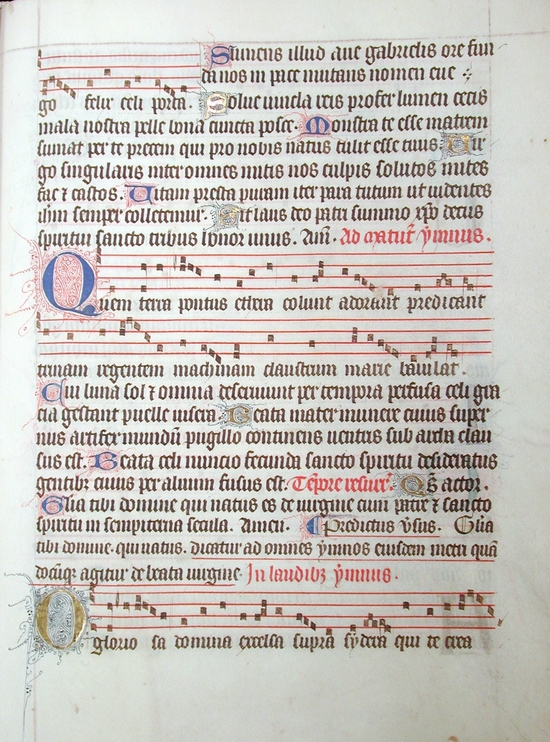
is never used at any other office on any other day; it's a really lovely tune with an unusual meter (11-11-11-11):
Here
it is sung by the Trappist monks of Gethsemani in Kentucky (Thomas
Merton's monastery - and he actually might have been singing here,
because the YouTube page says this recording is from 1958):
" in English. This hymn is also sung at Mattins on Purification (Candlemas).
Here are the words from Oremus; the note says "Words: attributed to Fortunatus, sixth century; trans. John Mason Neale, 1854."
so just sing it to the same tune, as prescribed.
, in Latin and English; the words above are clearly taken from the same original Latin text, so it's definitely the same song:
,
the Christmas Sequence Hymn, sung today at Second Vespers, as it is on
Candlemas also. Here's a lovely version, sung by the Gregorian Singers
of the Cremona Church of Sant’Abbondio:
The Feast of Saint Mary the Virgin - Marymas
August 15th
O
God, who hast taken to thyself the blessed Virgin Mary, mother of thy
incarnate Son: Grant that we, who have been redeemed by his blood, may
share with her the glory of thine eternal kingdom; through the same thy
Son Jesus Christ our Lord, who liveth and reigneth with thee, in the
unity of the Holy Spirit, one God, now and for ever. Amen. (Collect for the feast, 1979 BCP)

The
feast days of the saints are often referred to as their "heavenly
birthdays" since they ordinarily celebrate the day when the saint died
and thus passed into the new life of the Kingdom of Heaven. No one
illustrates this better than the Blessed Virgin Mary. Tradition relates
that, when the time of her death drew near, all of the apostles gathered
in Jerusalem to be with her--all except Thomas, who was preaching the
Gospel in India and was unable to return to Jerusalem in time. The
apostles gathered around her in a house on Mount Zion, near the Upper
Room where they had shared the Last Supper with Jesus and had also
received the Holy Spirit with Mary on Pentecost. In the charming
medieval carving at the left, John still appears quite youthful,
standing on the near side of her bed. Peter is wearing glasses and is
reading to her. When she died, the apostles carried her to a tomb in the
Garden of Gethsemane, which, tradition says, belonged to Mary's family.

Some
time later, the apostles discovered that Mary's tomb was empty. This
was not like the Resurrection of Jesus: Mary was not raised from the
dead and did not appear to the apostles after her death; nor did an
angel announce the news. Rather, her tomb was simply empty and they
concluded that she had been taken directly into heaven ("assumed"), in
much the same way that scripture and tradition attest that the greatest
saints of the Old Testament--Enoch, Moses, and Elijah--were taken up
bodily. In time, Thomas returned from India and the apostles told him
what had happened, together with their conviction that Mary had been
assumed into heaven. According to this tradition, Thomas once again
played the role of the doubter and insisted that he would have to see
the evidence before he would believe. At this point, we may perhaps be
forgiven for thinking that the tradition is a bit unfair to Thomas. It
hardly seems possible that this apostle who had traveled far and risked
much to share his faith would make the same mistake twice. Nevertheless,
the tradition has him going to the tomb of Mary where, instead of her
body, he found the tomb full of fragrant flowers--one version of the
tradition says the flowers were roses and lilies. And then, looking up,
he saw Mary herself, going up to heaven. Looking back, she saw Thomas
and dropped the girdle which had tied her robe and an angel delivered it
into the hands of Thomas.
It
was not until 1950 that the Assumption of Mary was defined as a dogma
of the Roman Catholic Church, when Pope Pius XII proclaimed that "the
ever-virgin Mary, having completed the course of her earthly life, was
assumed body and soul into heaven." In reality, however, this dogma was
nothing new. It simply made it a matter of obligation for Roman
Catholics to believe what many Christians have always believed, namely,
that God had "taken to himself," for eternity, the blessed woman who had
borne his incarnate Son in time. All believers look forward to "the
resurrection of the body and the life of the world to come." At the
Council of Chalcedon in 451, the emperor asked the patriarch of
Jerusalem to bring the relics of Mary to Constantinople so that they
could be enshrined at what was then the center of the world. The
patriarch replied that there were no relics because, as he said, the
apostles had found that her tomb was empty and her body had been assumed
into heaven: she had already gone where we all hope to go.
Some
Christians have difficulty with this idea because it is not in the
Bible (though, as we have already noted, the Bible does tell of others
who have been assumed, body and soul, into heaven). Nevertheless, Mary's
role in our salvation, and her particular relationship with God is a
pivotal one on our behalf. Her "yes" to the Archangel Gabriel opened the
way for God to take on our humanity, to become fully one with us in the
flesh. As an ancient prayer says, God humbled himself to share our
humanity in order that we might share in his divinity. In the moment
that Mary said "yes" to God's plan, she was already one with God in a
unique way, bearing within her body God himself. A connection such as
this transcends by far the intimacy of human relationships. Indeed, it
reaches beyond death--and so the Church believes.

At
the Council of Ephesus in 431, Mary was given the title
"Theotokos"--"God-bearer" or "Mother of God." Nestorius taught that the
divinity and humanity of Jesus were distinct and never mingled, so that
Mary was "Christotokos," the mother of the man Jesus, but not the mother
of God incarnate. The teaching of Nestorius was rejected by the Council
and Mary has been known ever since as Theotokos, in token of the fact
that she carried God himself in her womb, and continued ever after to
share a special union with him, both in life and in death. In the West,
Mary's feast on August 15th is called the Assumption. In the East it is
called
Koimesis--"Dormition" or "Falling Asleep." Both titles
are somewhat vague about the details. Indeed, in spite of the tradition
concerning Thomas's vision of her ascent into heaven, the Church is
officially silent on the way in which she got there. What is clear is
that, as our Collect says, God took Mary to himself, to be with him and
one with him for ever. And that is what we celebrate on this day.
There
are two places in Jerusalem associated with the end of Mary's earthly
life. One is the basilica in the Garden of Gethsemane (above) which
houses her tomb. The other is a monastery on Mount Zion on the
traditional site of her falling asleep. Dormition is the name the
community of German Benedictines have given to the Abbey that crowns
Mount Zion. A
life-sized sculpture of the Theotokos in
the crypt of the Abbey church shows the influence of traditional
Byzantine iconography. In the traditional Orthodox icon, Jesus himself
is depicted, standing by his Mother as she falls asleep, and holding her
soul, like a child, in his arm.
Taking
its cue from the experience of Thomas at the tomb of Mary, the
celebration of this feast includes the blessing of fragrant flowers and
herbs. Flowers have always been associated with Mary in a particular
way. She is the Mystical Rose and many flowers are named for her or have
popular names that relate to her. Here is a
link describing many of Mary's flowers. And here is another
link to a slide show with
more information about Mary's flowers and Mary Gardens. A Mary Garden
is a place to honor the Mother of God, as well as a place to go for
quiet reflection and prayer. It could also provide a setting for your
Easter Garden.
Mary Gardens may be found on the grounds of monasteries and churches,
and also in the gardens of private homes. They are planted with flowers,
herbs, and trees that are named for Mary or associated with her and her
Son in scripture and tradition. They may also have statuary, icons, and
other art and symbols that provide a focus for prayer and
contemplation. Ideally, a Mary Garden is enclosed to provide a place
truly set-apart, but even a dish garden can serve the purpose if
properly used as a means of focusing prayer.
August
is the wrong time to plant any kind of garden, but Marymas would be a
good day to begin planning and marking out a Mary Garden. Some plants
and seeds and bulbs do best if planted in the fall, and others can be
added in the spring. Here is a
link that will help you choose appropriate plants for your Mary Garden. In addition to the online resources linked above, Vincenzina Krymow's book
Mary's Flowers is
a beautifully illustrated text about the flowers associated with Mary
and their legends. It includes information about how to create your own
Mary Garden. Krymow has also written a companion volume,
Healing Plants of the Bible. (
Click here to find both of these books in our Bookshop.)
Llandaff
Cathedral in Wales has a unique variation on a Mary Garden which we
like a lot: each of the niches in the reredos of the Lady Chapel has a
sculpture of a flower named in Welsh in honor of Mary.
From
ancient times, in every culture, herbs and various flowers have been
known to have healing properties. The blessing of herbs and flowers on
Marymas is a way of "baptizing" the wisdom of traditional healing and
combining it with the Christian wisdom that recognizes that God is the
true source of healing and that salvation (wholeness) is ultimately
found only in the Son of Mary, Jesus Christ. Thus, it was customary for
the faithful to bring bunches of herbs and wild flowers to church on
this day. They were blessed at the beginning of the Eucharist and then
taken home to be used for healing and protection through the coming
year. For the renewal of this tradition, an abbreviated form of the
traditional prayers are found on our
Marymas Prayers page (click on the title).

In
many parishes and especially at shrines, this is a day for processions
and for celebrations that continue after the liturgical observances have
been completed. Traditionally, working people had a holiday from work,
so that there were also family celebrations. Today, we must be more
creative about marking these holidays in our homes, and it may be
necessary to transfer some of the celebration to the weekend in order to
keep the spirit of a fully homely divinity alive and healthy. If your
parish does not have a procession on this day, or if you are unable to
attend, why not have a family procession? Hymn singing does not require
an organ for accompaniment, and does not need to rival the Kings College
Choir in order to praise God in joyful song. (You will find an
assortment of good hymns on our
Sing of Mary page.)
Homemade banners can be as simple as strips of cloth waved by children,
or as elaborate as those with greater skills can make them. Our homes
can be filled with fragrant flowers and herbs. In the northern
hemisphere, this is an outdoor feast. If you do not have a Mary Garden,
any garden or park will serve--even the back porch, fitted out with
potted plants and cut flowers and herbs, will serve quite well.
 An
especially good, yet relatively simple way to celebrate this feast is
to have a tea party. A festive table can be set in your version of a
Mary Garden, which is already full of flowers. Perhaps a few Mary
flowers could be put in a small vase on the table. For drinks, we
suggest teas that are scented with herbs or made entirely with herbs, as
well as a fruit and herb punch from
our friends at Catholic Culture that children will enjoy. For those who
like old fashioned black teas, there are teas that are flavored with
roses--a natural for the feast of the Mystical Rose. Earl Grey tea is
another good choice as it is infused with Bergamot, a variety of
Monarda, or Bee Balm, which is also known as Sweet Mary. For food, at
the tea party, we suggest nasturtium sandwiches and strawberry
shortcake. It is a little late in the season for local strawberries but,
with modern refrigeration and transportation, it seems that almost any
fresh fruit or vegetable can be obtained year-round. The strawberry was
known as the "Fruitful Virgin" because it blooms and bears fruit at the
same time. Another lovely European tradition says that the strawberry is
sacred to Mary who accompanies children to keep them safe when they go
strawberry picking on St. John's Day. The nasturtium is known as "St.
Joseph's Flower." It is an edible flower and can be combined with cream
cheese to make tea sandwiches. Tea should be accompanied by prayers
appropriate to the occasion, such as the Collect of the Day which begins
this article. Children should be told the story of Mary's heavenly
birthday--how else will they learn it? Tomie de Paola's beautifully
illustrated book Mary: The Mother of Jesus (available in our Bookshop) tells the story reverently and well. Finally,
everyone will enjoy a walk in the garden which could easily be made
into a game, with an award, such as a Mary-blue ribbon, for the person
who identifies the most flowers and herbs that are named for Mary.
An
especially good, yet relatively simple way to celebrate this feast is
to have a tea party. A festive table can be set in your version of a
Mary Garden, which is already full of flowers. Perhaps a few Mary
flowers could be put in a small vase on the table. For drinks, we
suggest teas that are scented with herbs or made entirely with herbs, as
well as a fruit and herb punch from
our friends at Catholic Culture that children will enjoy. For those who
like old fashioned black teas, there are teas that are flavored with
roses--a natural for the feast of the Mystical Rose. Earl Grey tea is
another good choice as it is infused with Bergamot, a variety of
Monarda, or Bee Balm, which is also known as Sweet Mary. For food, at
the tea party, we suggest nasturtium sandwiches and strawberry
shortcake. It is a little late in the season for local strawberries but,
with modern refrigeration and transportation, it seems that almost any
fresh fruit or vegetable can be obtained year-round. The strawberry was
known as the "Fruitful Virgin" because it blooms and bears fruit at the
same time. Another lovely European tradition says that the strawberry is
sacred to Mary who accompanies children to keep them safe when they go
strawberry picking on St. John's Day. The nasturtium is known as "St.
Joseph's Flower." It is an edible flower and can be combined with cream
cheese to make tea sandwiches. Tea should be accompanied by prayers
appropriate to the occasion, such as the Collect of the Day which begins
this article. Children should be told the story of Mary's heavenly
birthday--how else will they learn it? Tomie de Paola's beautifully
illustrated book Mary: The Mother of Jesus (available in our Bookshop) tells the story reverently and well. Finally,
everyone will enjoy a walk in the garden which could easily be made
into a game, with an award, such as a Mary-blue ribbon, for the person
who identifies the most flowers and herbs that are named for Mary.
Feasts of Mary
Here is a list of some of the Feast Days which celebrate Mary and her role in our salvation:
September 24th - Our Lady of Walsingham
October 1st - The Protecting Veil of the Mother of God
November 1st - All Saints' Day (formerly Saint Mary and All Martyrs)
And
here's a peek-through to the SSM Breviary; rather than clicking the
link above, you can just scroll through the day's offices here, if you'd
rather: