Showing posts with label anglicanism. Show all posts

Monday, May 26, 2014

May 26: St. Augustine of Canterbury

Via JohnTheLutheran:
England was converted to the faith when St Augustine of Canterbury arrived on the island of Thanet with forty companions. They might have offered service and they probably preached, but they certainly settled down to Benedictine stability and contemplated God. That is one out of thousands of examples of the mystical process of spiritual power. It is mysterious but indisputable.

When we look at our contemporary trouble spots, at violence in the inner cities, at racial hatred, or torture, murder and rape, I can muster little faith in the efficacy of ‘praying about it’. I have absolute confidence in the efficacy of planting a contemplative community in the middle of it and letting God manifest his power. Prayer, real prayer, is no last resort but the first priority.

Martin Thornton, A Joyful Heart.

/via @martin_thornton


More about Augustine of Canterbury, Bishop and Missionary (26 May, 605), whose feast day it is today:
The Christian Church was established in the British Isles well before 300. Some scholars believe that it was introduced by missionaries from the Eastern or Greek-speaking half of the Mediterranean world. Celtic Christianity had its own distinctive culture, and Greek scholarship flourished in Ireland for several centuries after it had died elsewhere in Western Europe.

However, in the fifth century Britain was invaded by non-Christian Germanic tribes: the Angles, Saxons, and Jutes. They conquered the native Celtic Christians (despite resistance by, among others, a leader whose story has come down to us, doubtless with some exaggeration, as that of King Arthur), or drove them north and west into Cornwall, Wales, Scotland, and Ireland. From these regions Celtic Christian missionaries returned to England to preach the Gospel to the heathen invaders. 

Meanwhile, the Bishop of Rome, Gregory the Great, decided to send missionaries from Rome, a group of monks led by their prior, Augustine (not to be confused with the more  famous Augustine of Hippo). They arrived in Kent (the southeast corner of England) in 597, and the king, whose wife was a Christian, allowed them to settle and preach. Their preaching was outstandingly successful, the people were hungry for the Good News of salvation, and they made thousands of converts in a short time. In 601 the king himself was converted and baptised. Augustine was consecrated bishop and established his headquarters at Canterbury. From his day to the present, there has been an unbroken succession of archbishops of Canterbury.

In 603, he held a conference with the leaders of the already existing Christian congregations in Britain, but failed to reach an accomodation with them, largely due to his own tactlessness, and his insistence (contrary, it may be noted, to Gregory's explicit advice) on imposing Roman customs on a church long accustomed to its own traditions of worship. It is said that the British bishops, before going to meet Augustine, consulted a hermit with a reputation for wisdom and holiness, asking him, "Shall we accept this man as our leader, or not?" The hermit replied, "If, at your meeting, he rises to greet you, then accept him, but if he remains seated, then he is arrogant and unfit to lead, and you ought to reject him." Augustine, alas, remained seated. It took another sixty years before the breach was healed.


PRAYER (traditional language)

O Lord our God, who by thy Son Jesus Christ didst call thine Apostles and send them forth to preach the Gospel to the nations: We bless thy holy name for thy servant Augustine, first Archbishop of Canterbury, whose labors in propagating thy Church among the English people we commemorate today; and we pray that all whom thou dost call and send may do thy will, and bide thy time, and see thy glory; through Jesus Christ our Lord, who liveth and reigneth with thee and the Holy Spirit, one God, for ever and ever.

PRAYER (contemporary language)

O Lord our God, who by your Son Jesus Christ called your Apostles and sent them forth to preach the Gospel to the nations: We bless your holy name for your servant Augustine, first Archbishop of Canterbury, whose labors in propagating your Church among the English people we commemorate today; and we pray that all whom you call and send may do your will, and bide your time, and see your glory; through Jesus Christ our Lord, who lives and reigns with you and the Holy Spirit, one God, for ever and ever.


The readings for the day are here:
2 Corinthians 5:17-20a
Luke 5:1-11
Psalm 66:1-8 or
Psalm 103:1-4, 13-18


Here's Auggie carrying Canterbury Cathedral:


Once I get my post for "Common of Saints: Feasts of a Confessor" done, I'll link to it!


Saturday, January 25, 2014

Falling in love with God

“We Anglicans are not given to writing great theology. There are notable exceptions, but they are difficult to remember; but when Anglicanism is at its best its liturgy, its poetry, its music and its life can create a world of wonder in which it is very easy to fall in love with God. We are much more adept at the left hand than at the right.”
- Urban T. Holmes, What Is Anglicanism? 

Monday, January 20, 2014

"Electronic Anglican Breviary Project on Kickstarter"

For those interested in such things, Derek has launched his new Electronic Anglican Breviary Project on Kickstarter.  I (obviously!) love the fact that so much is happening online these days; there's so much available to us all these days that we might never even have known about in earlier eras.  And, Derek's the creator of the St. Bede's Breviary, so he's got some serious chops in this area.

Here's an excerpt from his post, with a link to the Kickstarter page if you'd care to support this effort.

Today I have officially launched a Kickstarter project to convert the Anglican Breviary to digital form and to make it available as a completely free web application.

For those not familiar with it, the Anglican Breviary is one of the great liturgical works that has come out of the Catholic movement in Anglicanism. 30 years in the making, it was produced in the year 1955 by the Frank Gavin Liturgical Foundation. Like all breviaries, it contains the traditional hours of prayers of the Western Church: the long early morning Matins office with its readings from the Church Fathers interspersed with psalms; the main offices for the hinges of the day, Lauds and Vespers; the daytime offices of Prime, Terce, Sext, None; the bedtime office of Compline; and the brief Capitular office that includes the martyrology recounting the saints to be remembered. Built on the structure of the Roman Catholic Divine Office according to the usage established by Pius X, it utilizes the Scriptures of the King James Bible and the Coverdale Psalms of the Book of Common Prayer to place these prayer hours within an Anglican idiom.

For more information on the Anglican Breviary itself, visit its home site at www.anglicanbreviary.net, owned and operated by Mr. Daniel Lula, the man responsible for keeping it in print. We have corresponded regarding this initiative, and I have his blessing to proceed.
More at the link.

Saturday, January 4, 2014

The merciful salvation of Christmas

This Christmas I went only to the Christmas Day Eucharist; I love this service, and I'm just as happy, to be honest, to skip Midnight Mass.  One reason I love it is that you usually get the Prologue to the Gospel of John, which I adore hearing on Christmas - but this time they used the Christmas II readings instead, so we got Luke's Nativity.  (Fortunately, I did hear the Prologue at Lessons & Carols the following Sunday; it's "the Last Gospel," read by the rector, and the climax of all the previous lessons!   Which is always perfectly splendid.)

Anyway, I read this piece at Fleming Rutledge's Generous Orthodoxy on Christmas Eve.  Here's the last part of it (my bolding):
In his new book about the Gospel of John, [Bishop Spong] declares that the milieu of the Gospel is not Hellenistic, but Jewish--as if he had personally discovered what has been common knowledge in biblical scholarship for at least sixty years. What struck me especially, though, was his repetition of the same ideas that he has been pushing for decades (with some degree of success, much to the annoyance of those of us who wish we had his genius for marketing). He is out to exterminate "salvation theology" and "atonement theology." He does not believe the human race and the creation need to be saved from anything. I am only slightly exaggerating in saying that he thinks the traditional apostolic faith is dangerous for our self-esteem. No one ever sought esteem more ravenously than Bishop Spong; he is famous for it. One wag said that his career did not belong to the history of theological inquiry; it belonged, like the career of the Sitwells, to the "history of publicity." In that regard, Spong has done a very effective job. My friend reported that during her retreat at the SSJE, one of the visiting participants burst out with a diatribe against "atonement theology."

Can it be that anyone could think this world is not in need of saving? Last week I saw a photo of a Syrian man holding the body of his little son, killed in a bomb blast. The father was howling. Howling. Yesterday  the New York Times published a very impressive piece of investigative journalism about the abysmal and inhumane conditions in the garment factories of Bangladesh where--get this--the US government pays megamillions (billions probably) to have clothes made for the Park Service, the Marine Corps, the Capitol security guards....all this evil done in our name and for our benefit, on the backs of poor, voiceless people in a distant country about which we know and care little.

A friend who writes pretty good poetry sent me a poem yesterday. I can't find it right now in the flurry of boxes, cards, decorations, etc. but it was something like this: "Lord, I don't feel like a great sinner, a little person with my little doings...." I think a lot of people feel that way, and it prevents us from understanding the seriousness of  the larger human predicament. "Into such a world as this" the Son of God became incarnate.

Isaiah writes, "We have been in our sins a long time; and shall we be saved?" (64:5) The message of Christmas is that, in the words of aged Simeon, "mine eyes have seen thy salvation" (Luke 2:30). If that be "salvation history," make the most of it.

Reading this ahead of time made me pay attention to whatever "salvation" themes might appear during the course of the Christmas Day liturgy - and I was surprised to hear them everywhere!  Here's another example of the "peeling of the onion" of the liturgy; we hear something new - something more and something deeper - every year, thanks to the repetition of the readings and prayers.

The Collect:
O God, you make us glad by the yearly festival of the birth of your only Son Jesus Christ: Grant that we, who joyfully receive him as our Redeemer, may with sure confidence behold him when he comes to be our Judge; who lives and reigns with you and the Holy Spirit, one God, now and for ever. Amen.

Isaiah 62:6-12 (which I don't actually remember ever hearing before!):
Upon your walls, O Jerusalem,
I have posted sentinels;
all day and all night
they shall never be silent.
You who remind the LORD,
take no rest,
and give him no rest
until he establishes Jerusalem
and makes it renowned throughout the earth.
The LORD has sworn by his right hand
and by his mighty arm:
I will not again give your grain
to be food for your enemies,
and foreigners shall not drink the wine
for which you have labored;
but those who garner it shall eat it
and praise the LORD,
and those who gather it shall drink it
in my holy courts.
Go through, go through the gates,
prepare the way for the people;
build up, build up the highway,
clear it of stones,
lift up an ensign over the peoples.
The LORD has proclaimed
to the end of the earth:
Say to daughter Zion,
"See, your salvation comes;
his reward is with him,
and his recompense before him."
They shall be called, "The Holy People,
The Redeemed of the LORD";
and you shall be called, "Sought Out,
A City Not Forsaken."

And especially, Titus 3:4-7, which is absolutely and perfectly to the point (although again I really dislike the thing about being "justified by grace"; that is just not, for me, what's happening at all):
When the goodness and loving kindness of God our Savior appeared, he saved us, not because of any works of righteousness that we had done, but according to his mercy, through the water of rebirth and renewal by the Holy Spirit. This Spirit he poured out on us richly through Jesus Christ our Savior, so that, having been justified by his grace, we might become heirs according to the hope of eternal life.

In was in the hymns, too:


The holly bears a blossom as white as lily flower,
And Mary bore sweet Jesus Christ to be our sweet saviour
Refrain
The holly bears a berry as red as any blood,
And Mary bore sweet Jesus Christ to do poor sinners good.
Refrain
The holly bears a prickle as sharp as any thorn,
And Mary bore sweet Jesus Christ on Christmas Day in the morn.
Refrain
The holly bears a bark as bitter as any gall,
And Mary bore sweet Jesus Christ for to redeem us all.
Refrain


The first three verses of "I Saw Three Ships" are these:
1. I saw three ships come sailing in,
    On Christmas day, on Christmas day,
I saw three ships come sailing in,
    On Christmas day in the morning.

2. And what was in those ships all three?
    On Christmas day, on Christmas day,
And what was in those ships all three?
    On Christmas day in the morning.

3. Our Saviour Christ and his lady
    On Christmas day, on Christmas day,
Our Saviour Christ and his lady,
    On Christmas day in the morning.


As noted here, the final verse of Personent Hodie in English is this:
On this day angels sing;
with their song earth shall ring,
praising Christ, heaven's King,
born on earth to save us;
peace and love he gave us.
Refrain

Rutledge wrote a followup to the original piece, which I read later:
Apropos of Advent and Christmas, I received an email from the curate at our church, Dane Boston, today:
Christmas becomes such a soggy, saccharine, sentimental mess if it is not accompanied with a serious, sober look at ourselves and our world.

I've been thinking lately about the first line of Dickens's A Christmas Carol, of all things: "Marley was dead: to begin with...This  must be distinctly understood, or nothing wonderful can come of the story I am going to relate." Gently tweaked, I think that's the preface to the Christmas Gospel: "We were dead: to begin with." Only when we've got that down does the wonderful story of Life incarnate coming to our world of death have any real meaning.
Isn't that wonderful? (See Ephesians 2:4-5).

It's just remarkable, I think, that a person can feel a piercing great joy and a perfect kind of ecstasy - at the very same time she's taking this "sober, serious look at ourselves and the world."  One can rejoice greatly for all the world - even as one knows the world is not nearly what it should be, and is sorrowing with those who sorrow.

I'm not as big on Reformation theology as somebody like Rutledge is; I'm an Incarnation girl, myself, and prefer the merciful salvation of Christmas to any other understanding of atonement.

One reason I feel evangelical these days, in fact, is because of my continuing hope that this great joy can overcome that great sorrow - just as the light overcame the darkness.

Lastly, I want to just leave, without comment the beautiful Bidding Prayer from Lessons & Carols, penned in 1918 by Eric Milner-White, a brilliant Anglican writer of prayers and collects (more on it, and him, later):
Beloved in Christ, in this Christmastide, let it be our care and delight to hear again the message of the Angels, and in heart and mind to go even unto Bethlehem, and see this thing which is come to pass, and the Babe lying in the manger.

Let us read and mark in Holy Scripture the tale of the loving purposes of God from the first days of our disobedience unto the glorious Redemption brought us by this holy Child; and let us make this place glad with our carols of praise.

But first, let us pray for the needs of his whole world; for peace and goodwill over all the earth; for the mission and unity of the Church for which he died, and especially in this country and within this city.

And because this of all things would rejoice his heart, let us at this time remember in his name the poor and the helpless; the hungry and the oppressed; the sick and those who mourn; the lonely and the unloved; the aged and the little children; and all those who know not the Lord Jesus, or who love him not, or who by sin have grieved his heart of love.

Lastly, let us remember before God his pure and lowly Mother, and all those who rejoice with us, but upon another shore and in a greater light, that multitude which no one can number, whose hope was in the Word made flesh, and with whom, in this Lord Jesus, we for evermore are one.

These prayers and praises let us humbly offer up to the throne of heaven, in the words which Christ himself hath taught us:

Our Father...

(Can I just point out that many people from other traditions churches say they are envious of the beauty of Anglican liturgy?  We would all do well to appreciate it more deeply ourselves, I do believe....)


Tuesday, November 5, 2013

"Happy Hallowmas!"

Fantastic article this week from Anglicans Online; check out the "Find a Grave" section.....
Hallo again to all.

Happy Hallowmas! Yes, that is easier to say than 'Have a happy triduum of All Hallows'.

Hallowmas, the Triduum of All Saints, the Triduum of All Hallows. Whatever it might be called, it's a time to remember the dead. Its three days are All Hallows Eve, All Hallows Day (All Saints Day), and the Day of All Souls. In countries that were once British colonies, the general public is very aware of All Hallows Eve, has probably heard of All Saints Day, and usually conflate All Saints Day with All Souls Day if they find the need to mention either.

We like to conflate the three days of the Hallowmas Triduum, even though we have carefully educated ourselves on the theological and historical nuances of each. The silly celebrations of Hallowe'en, the church service celebrating All Saints, the somber reflections on All Souls. While no child is likely to go guising on All Hallows Day itself, adults can remember and pray for the souls of the departed even while waiting for the next disguised child to say 'trick or treat'.

In Mexico, the entire Triduum is called 'Dรญa de los Muertos' (Day of the Dead), though there are day-to-day nuances embodied more in local tradition than in formal scholarship. Mexican celebrations prominently feature skulls and skeletons as decor, not to scare children but to help remember and celebrate the dead.

It is nice to have time set aside each year for remembrance of the dead. But the mechanics of such remembrance have become more complex through the centuries. Once there were churchyards, and friends and family were actually interred there. One could stop at their headstones on the way to church each Sunday, to remember and pray. No more. There are now so many choices for final resting places that one can not make assumptions.

What to do? Can technology help? We at AO often reflect on the many ways that communication technology has enabled change to longstanding traditions. The internet might well have killed newspapers, but it didn't kill churchyard burials and Sunday visitations thereto. Those practices died a natural death, quite unaware of bits and bytes and bauds.

We claim that the answer is 'Yes, technology can help make up for our inabiity to remember our dead by visiting churchyards.'

Two characteristics of the internet come into play here. If you are going to look at something online, then it doesn't matter where it is. Distance and location don't matter. And the internet enables anyone and everyone to broadcast information in a manner once available only to owners of radio stations and publishing companies. No one is obligated to read what you write or say, but anyone can, and those who can might tell their friends about it. These two characteristics combine to enable a process widely known as 'crowdsourcing'.

When distance doesn't matter and crowdsourcing works, then something like Find a Grave can exist and flourish. And flourish it does. The server computers that sustain it can be anywhere*.   Crowdsourcing technology enables thousands of people all over the world to enter information and photographs. You can in a twinkling visit the gravesites of C S Lewis, St Augustine of Canterbury, Frederick Temple, Thomas Tallis, George Herbert, or Omar Khayyam.

Now that Find a Grave exists and has done its flourishing for a while, the notion of virtual churchyards becomes entirely practical. You can make a virtual churchyard that contains links to the grave records of a geographically diverse set of people. While viewing online a photograph of a gravestone is not at all the same experience as touching it and smelling it and kneeling in front of it to pray, it is certainly better than nothing and is a good way to remember, to keep alive the memory of the dead. Maybe someday in the future some kind soul might make a virtual churchyard of all of us who work on Anglicans Online.

We'll probably submit to Find a Grave a better picture of the Portland Stone marker at the grave of former Anglicans Online worker Frederic McFarland. But that marker, designed by Lida Kindersley and hand chiseled by one of her lettercutters, is something that must be seen and touched and walked around in order to understand fully.** The virtual world is better than isolation, but there is not any substitute for being there.

See you next week. Right here, which, um, is online and virtual.


3 November 2013

http://anglicansonline.org
*Not that it matters, but the Find A Grave server is in Salt Lake City.
**Frederic McFarland's headsone is the only Kindersley work installed in North America.

Wednesday, September 25, 2013

The trouble with Anglicanism....

While it is a very wonderful, sane, healthy way to be Christian, it has no clue whatsoever why anybody should become a Christian.  I submit that Anglicanism does not itself know what faith is actually for, or why it's a good thing for human beings to pursue it.    It does know, I hasten to add, that one of faith's important roles is to "to give praise to God."  And that's great, I do acknowledge - but perfectly doable on one's own time, no?  And does worship - i.e., the famous "liturgy" - actually do much to help people just by itself?  Perhaps, for some people it does - those with a previous faith background and some understanding of faith practices (or those with a lot of patience - and a priest who uses the Prayer Book well) - but I'm not sure this idea is working very well these days.

The trouble with Anglicanism - and particularly the American version of it - is that it has no theology of human nature, and no particular thoughts - or perhaps rather  some trivial and at the same time contradictory thoughts - about the human condition itself (AKA "the heartache and the thousand natural shocks that flesh is heir to" - plus "alienation from God").    It's the original "I'm OK, you're OK" religion - so how can it help anybody who isn't actually OK?  Answer:  it can't. 

If Anglicanism wants to discuss the human condition, it must borrow anthropological ideas from elsewhere - Catholicism has some well-developed ones, and Lutheranism has some more modern and psychologically interesting (and dramatic!) ones; the most interesting ideas, from our perspective, might be the Girardian ones - but it has totally forgotten that this is possible or desirable.   It simply doesn't speak of any of these things.

So, what you get are people who actually are OK (sounds unlikely to me), or who believe they are OK - or those who seem to be OK, or pretend to be OK.  And since everybody's OK, well:  there's nothing to see here, folks.  We have to hurry to get out there to help all the people who aren't OK - but only the actual poor and needy, please.  Let's just leave the troubled or addicted - and, for that matter, the "poor in spirit" - out of this, can we?  And remember:  it's just plain selfish to focus on your own problems!

Actually, though:  there is a tiny touch of reporting on the human condition in the 39 Articles:
IX. Of Original or Birth-Sin.
Original sin standeth not in the following of Adam, (as the Pelagians do vainly talk;) but it is the fault and corruption of the Nature of every man, that naturally is engendered of the offspring of Adam; whereby man is very far gone from original righteousness, and is of his own nature inclined to evil, so that the flesh lusteth always contrary to the Spirit; and therefore in every person born into this world, it deserveth God's wrath and damnation. And this infection of nature doth remain, yea in them that are regenerated; whereby the lust of the flesh, called in Greek, p¢vnรฆa sapk¢s, (which some do expound the wisdom, some sensuality, some the affection, some the desire, of the flesh), is not subject to the Law of God. And although there is no condemnation for them that believe and are baptized; yet the Apostle doth confess, that concupiscence and lust hath of itself the nature of sin.

X. Of Free-Will.
The condition of Man after the fall of Adam is such, that he cannot turn and prepare himself, by his own natural strength and good works, to faith; and calling upon God. Wherefore we have no power to do good works pleasant and acceptable to God, without the grace of God by Christ preventing us, that we may have a good will, and working with us, when we have that good will.

XI. Of the Justification of Man.
We are accounted righteous before God, only for the merit of our Lord and Saviour Jesus Christ by Faith, and not for our own works or deservings. Wherefore, that we are justified by Faith only, is a most wholesome Doctrine, and very full of comfort, as more largely is expressed in the Homily of Justification.

But, of course:  the 39 Articles?  What the heck are those?

And you do get a bit about the Ten Commandments in the Catechism.  But there's a bit of a problem - kind of a large gap, in fact - in the thinking, given the issues enumerated in the articles above, isn't there?    How does one, in other words, actually get from there to here?  Seems to be a mystery.

Q.    What are the Ten Commandments?
A.    The Ten Commandments are the laws give to Moses and the people of Israel.
    
Q.    What do we learn from these commandments?
A.    We learn two things: our duty to God, and our duty to our neighbors.
    
Q.    What is our duty to God?
A.    Our duty is to believe and trust in God;
     I       To love and obey God and to bring others to know him;
     II       To put nothing in the place of God;
     III       To show God respect in thought, word, and deed;
     IV       And to set aside regular times for worship, prayer, and the study of God's ways.

Q.    What is our duty to our neighbors?
A.    Our duty to our neighbors is to love them as ourselves, and to do to other people as we wish them to do to us;
     V      To love, honor, and help our parents and family; to honor those in authority, and to meet their just demands;
     VI      To show respect for the life God has given us; to work and pray for peace; to bear no malice, prejudice, or hatred in our hearts; and to be kind to all the creatures of God;
     VII      To use our bodily desires as God intended;
     VIII      To be honest and fair in our dealings; to seek justice, freedom, and the necessities of life for all people; and to use our talents and possessions as ones who must answer for them to God;
     IX      To speak the truth, and not to mislead others by our silence;
     X      To resist temptations to envy, greed, and jealousy; to rejoice in other people's gifts and graces; and to do our duty for the love of God, who has called us into fellowship with him.


We're also told that "It is required that we should examine our lives, repent of our sins, and be in love and charity with all people" before receiving Communion.   Well, that's certainly nice - but again:  how is one supposed to accomplish any of this, if we are "very far gone from original righteousness, and of our nature inclined to evil"?

If we've dropped the 39 Articles because we don't actually believe that  we are "very far gone from original righteousness, and of our nature inclined to evil" - well, what do we believe about any of this?  That we're all OK?  That people really have no deep sorrows or pains or lonelinesses or obsessions or addictions or frustrations or feelings of alienation or self- or other-destructive impulses or habits?  That we can just naturally accomplish, on our own steam, all the things listed in the Commandments section above?  And that there's nothing more to worry about, as long as we don't steal from our places of employment?

And if we can accomplish all those things on our own - then just what is it we are being "saved" from?

Inquiring minds want to know.....


Tuesday, July 23, 2013

How it's done

Another of Caelius' posts made me think about what makes the difference between a thriving parish and the ones that are sick or dying out.   The parish I attend now is a thriving one; in fact, it's one of the few I'm aware of in my diocese that is healthy and growing.

Here are some of my thoughts about why that has happened:
  • Worship and faith.  There are 4 masses on Sunday (3 in the summer) - one being a 6 p.m. "Last Chance" mass. There is at least one prayer service every day, and I think on two days of the week a mass, too. Not very many come to these, usually - but the services are offered nonetheless, every day. The rector is a woman, and Anglo-Catholic in approach; most of the parishioners are pretty middle-of-the-road, though. There's a crucifix on the wall, but no other obvious signs of Anglo-Catholicism; they use no incense (except perhaps on special occasions - but I've never seen it).   (Oh, wait:  they do ring bells during the Consecration.)  Feast days for the upcoming week are listed in the weekly announcements bulletin that comes with the service bulletin. 

    The music director offers a great variety of hymns from the 1982 Hymnal, and occasionally hymns from other sources.  Hymns are briskly paced; this, I think, is actually more important than anybody would think.   The litany is sung on Advent 1 and Lent 1, and the late service is Rite 1 on the first Sunday of each month.  The congregation sings all the ordinary parts of the mass except the Creed; we sing the Pascha Nostrum instead of the Gloria during Easter, to Anglican Chant, and other seasonal anthems and canticles at other times of the year; we sing the Psalm except in summer when it's said.  (There are only two readings and the Psalm each week; the third is printed in the bulletin.)    The choir sings a great variety of music of all kinds, from all over the world. 

    I look very much forward to going every week, because I can count on a respectfully done and intelligent liturgy that I know well and don't have to feel afraid of.  I can absolutely rely on its detoxifying effects - and I feel, when I don't go, that I've missed something important.

  • Care for members and others:  Many families belong, and there are many kids;  many or most of the kids are part of the very strong choir program. The parish does a lot of service in the neighborhood and around the diocese and beyond; they give service a very important place in their hierarchy of values, and are involved in many long-term projects. 

    For instance, they are helping a parish destroyed by last year's hurricane with rebuilding, and donate Prayer Books, etc.  This parish gets prayed for every Sunday.  They also raise money for some of the poorer churches in the area. The kids of the parish worked to raise money to buy a service dog for a young boy, also a member, who had a degenerative disease; he died eventually, though, before they could give him the dog - and they mourned deeply for him.   That's probably one of the most important things they'll ever have done in their lives; this kind of direct, personal care is even more important, I think, than almost any other kind of service.   Prayers for special days in the lives of members always come  from the Prayer Book; we pray once a month for those celebrating wedding anniversaries - and I believe I saw the beautiful Prayer #45, "For Families," used on Mother's Day. 

    There's an independent nonprofit counseling center on the grounds, originally founded by members of the parish.  While it's independent, its presence produces a feeling of confidence that there are people close by you could go to for help if you needed it.   I used to go to this parish for the Office and for things like Stations of the Cross, and the clergy remembered and welcomed me warmly when I started coming on Sundays, too.

  • Stability.  The rector has been there for almost 20 years; I think this makes a huge difference.  It might be the single most important factor, actually, given her un-selfconscious Anglo-Catholic approach; there are also strong lay leaders who do a great deal of service (and officiate at the Daily Offices).  All of this is a great example of consistency, constancy, grounding in prayer, and dedication.  Consistent, dependable worship services every day of each week, and leaders who continue to be willing to spend their energy on all this, every week, for two decades:  that's an impressive legacy these days.   I believe the average tenure of a priest now is less than 6 years, and continues to shrink.  

    The rector always seems to hire young curates, usually somebody recently ordained; this means that the rector must preside at every mass, for at least six months - but she continues this practice faithfully.  They get very good training.  The music director, too, has been there for a couple of decades; she has her own choral ensemble outside the parish which is well known and highly regarded in the local area.  

    What has made the difference here is that the rector - and I think the music director, too - have actually dedicated the greater part of their work lives (and thus their hearts) to this parish.  They have built up something meant to last; they are, unfortunately, a vanished breed - but they are the ones who've made this parish what it is.  It's this kind of long-term dedication and constancy that matters.
  • Energy.  It may be quite difficult to combine this kind of long-view investment in stability with energy and freshness and openness to new ideas, but they are able to do it.  This seems to me the absolute best of Anglicanism, actually.

  • Egos checked at the door.   Every service is done by the book (the 1979 BCP, that is); rubrics are followed.  This demonstrates that the rector is able to keep her own ego in check, and can obey rules.  It also helps the congregation to memorize the service so we can actually pray, and not have to be looking down at the bulletin all the time.  The music director uses settings everybody knows for the service music.  Nobody makes any attempt to be special, cute, or to put an individual spin on any part of the liturgy.    Nobody's there for the sake of attracting attention to themselves, or to power-drive their own agendas over everybody else.  (You might be surprised how hard this is to come by!)

    The fact that the rector is able to low-key her Anglo-Catholicism, for the sake of her parishioners' worship style, yet still live by, and teach and preach it - well, that's another example of the ability to "check one's ego at the door." And, BTW: it also demonstrates that Anglo-Catholicism is not actually mostly about birettas.

  • Helping kids.   The choirs are very important to the kids and the parents, it's clear.  There are also scholarships for seniors going to college; choir trips to RSCM events during the summer; pilgrimages (they just went to a New Mexico monastery) and mission trips; summer Bible school; movie nights; Compline for Kids; pizza nights.  The music program is very central, though - and brings kids from other neighborhoods in, too, and other choirs, and other people who like to sing.  What's important about this is the same thing we always talk about:  healthy, grounded, dependable faith is a slow process.  People aren't going to get it immediately; after all, it took me 10 years to really feel at home with almost everything in the liturgy.  So have people sing, while they're waiting and learning!  Give them something valuable while you're teaching them something even more valuable.


I really don't think it's more complicated than that - but of course, that's a lot.  This church is growing and healthy; they are actually spending money building, rather than digging into their endowment.   All this, in a college town in the Northeast.

There is a lot going on, thanks to a dedicated, energetic, extremely hard-working, faithful rector who doesn't think it's all about her, and works at helping people find a stable, rich, beneficial  faith - something that's clearly at the very center of her own life.

The Episcopal Church really doesn't have to die, you know.

Thursday, May 30, 2013

Angels

Via Akenside Press:
John Macquarrie on the doctrine of angels: it "directs our minds to the vastness and richness of creation."
The concept of the angelic stands for the unity and order of the whole creation in the service of Being; not merely at the level of cosmic process, but at the level of conscious and free cooperation. God has 'ordained and constituted the services of angels and men in a wonderful order' (BCP Collect). Man is sometimes afflicted with a sense of loneliness on his little planet, the only 'existent' upon earth, perhaps just an accident in the cosmos. But if the Christian doctrine of creation is true, then man is no accident, and presumably he is not alone. He must be one of countless races of beings on which the Creator has conferred being, and some of these races must, like man himself, have risen to consciousness and freedom whereby they can gladly cooperate with God. Some must have moved further in the hierarchy of beings, so that they constitute higher orders of creaturely beings. The doctrine of the angels opens our eyes to this vast, unimaginable cooperative striving and service, as all things seek to be like God and to attain fullness of being in him. One may recall here the story of Elisha's servant whose courage was renewed by a vision of supporting angels.
This incident is particularly relevant for understanding the significance of the angels in a contemporary formulation of the doctrine of creation. The doctrine of the angels directs our minds to the vastness and richness of the creation, and every advance of science opens up still more distant horizons. Any merely humanistic creed that makes man the measure of all things or regards him as the sole author of values is narrow and parochial. The panorama of creation must be far more breathtaking than we can guess in our corner of the cosmos, for there must be many higher orders of beings whose service is joined with ours under God.

(from Principles of Christian Theology, X.40.xi-xii)

Wednesday, April 24, 2013

"The Society of St. Julian"

How does that grab you as the namesake and patron for our new lay religious society?

I'd wanted to be a bit more "ecumenical" - that is to say, to avoid a specifically English slant on the thing.  But then, if I'd chosen St. Francis it would be an Italian slant.  If St. John of the Cross (definitely another possibility) it would be a Spanish slant.

So one way or another, we're going to have to deal with geographyPerhaps The Society of St. John and St. Julian?  That way we mix it up a bit - and "reform" comes into the mix, too.

I really have to finish Revelations of Divine Love, though!  It's actually a little bit embarrassing that here I am proposing to name a society after her - and I haven't even read all the way through her only work.  I'm in the middle of reading it now - but I have read a lot of St. John, so I've at least got that going for me. 

Full Homely Divinity uses St. Julian as an unofficial patron - and our old friend The Postulant has written liturgies based on her writings.  I'm pretty sure that's good enough for me.

What about you?  I do hate to leave St. Francis out of it, but some guy already went there this year, so maybe that's enough....

Saturday, March 16, 2013

"Why be a liberal Catholic when you could be an Anglican?"

This, from Theo Hobson in the Guardian; note the section I've bolded below, which is a discussion of the idea of a "Cultural Anglicanism" I talked about here a couple of months ago.  It's also helpful to think about it in relation to the David Brooks article I posted here yesterday.
What's the appeal of Roman Catholicism to a fairly liberal person? Why don't they jump ship? They say they dislike clerical celibacy, which they largely blame for the abuse scandals. Well, there's a church close at hand that rejects it. They say they want to see the ordination of women. Well, there's a church close at hand that ordains women (more or less). They say they dislike the church's intransigence on homosexuality. Well, there's a church close at hand that has an honest, messy debate about this issue. They say they dislike the church's legalistic approach to birth control, abortion, and various other moral issues. Well, there's a church close at hand that rejects such an approach. They say they dislike the church's authoritarian structure, the monarchical aura of the papacy. Well, you know what.

Why do they stay in a church that is so full of things they dislike, when there is one close at hand that is more or less free of those objectionable things? Presumably they would reply: because, despite everything, the Roman church seems to us the authentic church, and the Anglican church does not. But there is a sector of Anglicanism whose style of worship is scarcely distinguishable from that of Roman Catholicism. Yes, they might reply, but the institution lacks authenticity: it was founded by a randy monarch, and remains confined by its national character. Fair point perhaps, but does it really outweigh the benefits of Anglicanism to a liberal believer? Is this really a reason to stay in an authoritarian, illiberal church – that at least it wasn't founded by Henry VIII? The man had his faults but he wasn't Satan.

So what's Rome's appeal to these people? Is it that they want the prestige of belonging to an exotically large, old tradition? Do they feel a sort of thrill to be connected with an institution that strikes their friends as baffling, mysterious, romantically gothic? Do they like seeing eyebrows raised at dinner parties, when they state their allegiance?

This might be a factor, but it misses the central point. It seems to me that the central appeal of Roman Catholicism is its bold insistence that Christianity must be embodied in culture. For Catholics, religion is not confined to a carefully demarcated sphere, or to the realm of individual faith: it must be holistic, public, all-embracing – it demands to be known as the meaning of cultural life. By contrast, Anglicanism seems to accept the marginalisation of religion, and seems to approve of liberal culture. Religion is a wonderfully rich bit of culture, Anglicanism seems to say, but it's just one bit of culture; it knows its place. No, says Catholicism: the place of religion is everywhere; its role is to be everything.

I first got thinking about the greater cultural richness of Catholicism when Pope John Paul II died: I was fascinated by the spectacle of pilgrimage and devotion that ensued. Among the television coverage was some footage of his visit to Britain in 1982, complete with huge rallies and open-air masses and people fainting with excitement. It struck me that Roman Catholicism has the character of a constant carnival, a world-sized show. Soon afterwards I was in holiday in Spain for Good Friday, and the old walled town was abuzz with amateur theatricals: Roman soldiers on horses, huge lines of people in those eerie pointy KKK-like hoods such as the ones Goya painted. This is something that no form of Protestantism offers: the sense of a whole culture joining together in religious ritual.

I had the same feeling when the relics of St Thรฉrรจse of Lisieux toured Britain: there was much sceptical press comment about the irrationality of Catholicism, but I looked on with a sort of sacramental envy, as excited crowds queued to be near the dead nun's bones (as I explained at the time).

Incidentally, on the subject of relics, John Henry Newman had a sure grasp of this aspect of Catholicism's appeal. In his Apologia Pro Vita Sua he poetically defended popular devotions that made dry Anglicans angry. Devotion to relics should be seen as a powerful form of popular culture, he said. "Why then may not the country people come up, in joyous companies, singing and piping, to see the Holy Coat at Trรจves?"

My response is mixed. I chiefly view Roman Catholicism through liberal Protestant eyes: it is an intolerably reactionary version of Christianity. On the other hand, liberal Christianity ought to imitate huge aspects of its cultural richness, of its bold belief in religion as culture. We should not turn away in puritan distaste from the tradition of colourful public religion.

Again, though:  I think this is an overly - and unhelpfully - "liturgical" way of thinking about the issue.  The reason Catholicism can do this is not because it likes to do big, colorful, public rites and rituals; it's because of what it teaches about Christianity and its place in the world.

Remember what Brooks said in that article, about Augustine's idea that "the church should go on offense and swallow the world"?  This is the missing piece; the liturgy is a reflection of this idea - it's a teaching method, not a feature standing alone.  If Anglicanism doesn't teach this - and, as far as I can tell, it doesn't - it won't appear in its liturgy.  It's an idea - and I think Hobson's right that "Protestantism" does not contain this idea, because its origin comes out of an attempt to get the church of its time to stop its "swallowing of the world."

That's because the church of its time was corrupt - but of course, the movement went too far, as reactionary movements always do.   Protestantism - of every variety  - is now more concerned with self-referential "purity" (again, as Brooks noted) than with the healing of the world. It's certainly not "deeply preoccupied by the idea of the basic unity of the human race," as Brooks says Augustine was.

Brooks continues, remember, this way: 
He wanted the church to go on offense and swallow the world. This would involve swallowing impurities as well as purities. It would mean putting to use those who are imperfect. This was the price to be paid if you wanted an active church coexisting with sinners, disciplining and rebuking them.

In this view, the church would be attractive because it was hungering and thirsting for fulfillment. Far from being a stable ark, the church would be a dynamic, ever-changing network, propelled onto the streets by its own tensions. Augustine had this deep, volatile personality. His ideal church was firmly rooted in doctrine, but yearning for discovery.

Think, too, at that point, about James Alison's view of the church as "halfway house" - and perhaps add in Father Paissy's thought from TBK:
"You are completely misunderstanding it," said Father Paissy sternly. "Understand: the Church is not to be transformed into the State. That is Rome and its dream. That is the third temptation of the devil. On the contrary, the State is transformed into the Church, will ascend and become a Church over the whole world — which is the complete opposite of Ultramontanism and Rome, and your interpretation, and is only the glorious destiny ordained for the Orthodox Church. This star will arise in the east!"
That is where "cultural Catholicism" (or "cultural Orthodoxy" - or "cultural Anglicanism") comes from.  It can't be had by tinkering with the liturgy; it's got to be a teaching.   It's got to be based on a way of thinking - which is why Anglican fixation with "liturgy" will never be the cure.  The church is a hospital for the whole world - not a haven for the "righteous."  This is the central idea here - and it's crucial to reclaim it.

The church simply cannot presume that anybody, from now on, understands what Christianity is for- still less, that anybody "believes" it.  It can't assume that anybody's grown up with a firm sense of what Christianity is about - of what its value is.  I think perhaps people who've always been involved in it simply don't consider these things very deeply; they don't know what it's like to live without faith, so they don't ask these very basic questions.  The Episcopal Catechism - I'll say it for the hundredth time! - assumes what it's setting out to "prove."  Or, rather, it assumes it doesn't have to answer deeper questions; it assumes that everybody's already hooked into the faith - something that's manifestly not true, even in terms of its own membership.

Again, take a close look at the Catholic Catechism and note what it's trying to do; it uses language and ideas that anybody can understand.  It tries to make a case.  It doesn't assume that these ideas are self-evident.

Tuesday, December 18, 2012

"Communities of Advent hope"

Here's a really nice post at catholicity and covenant: "Communities of Advent hope: +Sheffield and the priority of 'forming and shaping disciples'"

+Steven Croft (Bishop of Sheffield) has an excellent blog post urging the Church to be authentically shaped by the Advent hope.  Amidst the complexities of "the deep shifting of the tectonic plates of our society", it is all-too easy for the Church to embrace what he terms "the failure narrative".  The response to this is not to be a complacent, lazy acceptance of the social and cultural status quo (secularisation).  Rather, "our vocation is to be a people of hope".  

To be communities of Advent hope, churches are called "to steadily shift our resources to the process of forming and shaping disciples":

This means recovering, encouraging and in
some case discovering afresh the great classical intellectual disciplines and pastoral practices which the Church has always needed in such moments of cultural change.

These include:
  • Apologetics: defending and commending the faith through philosophy, the sciences, the arts and popular culture
  • Contextual mission: the ability to go beyond the church in loving service and careful listening, to pioneer new ecclesial communities as part of the wider church
  • Initial proclamation: the loving and careful communication of the gospel to those who have not heard it before
  • Catechetics: the intentional nurture and formation of disciples who are well grounded in faith and able to live counterculturally.

These disciplines will be the engine room of the Church in the next generation.  Any church which wants to move forwards (and by church I mean local church or diocese or denomination) must steadily shift resources and creativity and energy towards these four great disciplines.  They need to be at the heart of ministerial training and ministerial practice and at the core of our theological endeavor.

It is a superb summary of what we are called to do and be in the social and cultural context experienced by North Atlantic Anglicanism early in the 21st century.  This four-fold agenda - apologetics, contextual mission, initial proclamation, catechetics - could easily be adopted by any parish, diocese, seminary, fresh expression, or House of Bishops within North Atlantic Anglicanism to shape its mission and witness.  Indeed, we might go as far as to say that any diocese, seminary or House of Bishops not seriously reflecting on this agenda has very serious questions to ask itself.

That it is a bishop from the catholic Anglican tradition who is urging this should also be noted.  After catholic Anglicans being caught up in Anglicanism's culture wars over the past generation, the pressing need to lift our eyes (and - as +Steven Croft reminds us - our hearts) is very evident.  Our energies and enthusiasms have been absorbed in debates and divisions rather than in the making and nurturing of disciples.  +Sheffield points us back to what should be central to a catholic Anglican witness.
It is all about hope - "not something we feel but something we practise".  To be shaped by the Advent hope in the midst of globalisation and secularisation is not to hanker after a past (and mythical) ecclesial and cultural golden age.  Nor is it to become the bland, inoffensive spiritual expression of the contemporary zeitgeist.  It is, rather, to more convincingly and authentically relate, live out and share the evangelium and traditio in the midst of the city in which we find ourselves.  And this requires of us a fresh recovery of apologetics, contextual mission, initial proclamation and catechetics.

Tuesday, December 4, 2012

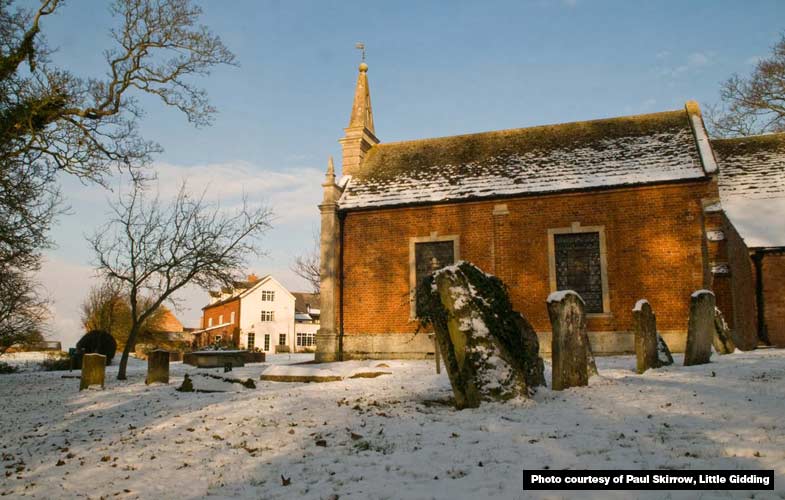
"'Frost and fire': commemorating Nicholas Ferrar in Advent"

From catholicity and covenant today:

... pentecostal fire
In the dark time of year.

Eliot's words from Little Gidding speak to us as we commemorate Nicholas Ferrar at the beginning of Advent.  In the northern hemisphere it is a time of frost and darkness, but Advent lights burn.  Such was Ferrar and the community of Little Gidding.  In a cold time - a time of bitter conflict and of deep fear - the prayerful rhythms of Little Gidding spoke of the Kingdom.

For all of the gentleness and civility of Little Gidding, its life - those prayerful rhythms - profoundly challenged the polities of this world.  In his sermon during this year's Little Gidding pilgrimage, Bishop of Ely Stephen Conway, pointed to this challenge: 

It was not some romantic aesthetic withdrawal from the world but a bold and sober dedication to what the world really needs which is metanoia, being purged and transformed by the fire of love.

Little Gidding is indeed "tongued with fire", an example in a cold time of how Anglican communities can be signs of the Advent hope.

(The photograph is of Little Gidding Church and the Ferrar House in winter.)

I went to church on Advent I - I had a real longing to be there - to a parish I used to go to for Morning and Evening Prayer (one of the few around here that offer at least one of these every day).  And the priests - and some parishioners - remembered me, and greeted me kindly and warmly; I had forgotten that could happen.

It's a more-or-less Anglo-Catholic parish.  A real one, that is - no ostentation about it, but a place where the real faith is preached - and that is the central purpose.  No incense - but a small crucifix on the wall, and the unaltered words from the BCP during the rite.  I had forgotten that was possible, too.  Maybe there's a place for me, after all;  a Little Gidding in the middle of all the "bitter conflict."  I certainly could use the spiritual help....

Tuesday, October 23, 2012

"Read the Catechism: Day 13" vs. "Article XIX"


Today's reading from the Catechism of the Catholic Church:
Part1:The Profession of Faith (26 - 1065)
Section1:"I Believe" — "We Believe" (26 - 184)
Chapter2:God Comes to Meet Man (50 - 141)
Article2:The Transmission of Divine Revelation (74 - 100)


III. THE INTERPRETATION OF THE HERITAGE OF FAITH


The dogmas of the faith
88     The Church's Magisterium exercises the authority it holds from Christ to the fullest extent when it defines dogmas, that is, when it proposes, in a form obliging the Christian people to an irrevocable adherence of faith, truths contained in divine Revelation or also when it proposes, in a definitive way, truths having a necessary connection with these.

89     There is an organic connection between our spiritual life and the dogmas. Dogmas are lights along the path of faith; they illuminate it and make it secure. Conversely, if our life is upright, our intellect and heart will be open to welcome the light shed by the dogmas of faith.

90     The mutual connections between dogmas, and their coherence, can be found in the whole of the Revelation of the mystery of Christ. "In Catholic doctrine there exists an order or hierarchy of truths, since they vary in their relation to the foundation of the Christian faith."

The supernatural sense of faith
91     All the faithful share in understanding and handing on revealed truth. They have received the anointing of the Holy Spirit, who instructs them and guides them into all truth.

92     "The whole body of the faithful... cannot err in matters of belief. This characteristic is shown in the supernatural appreciation of faith (sensus fidei) on the part of the whole people, when, from the bishops to the last of the faithful, they manifest a universal consent in matters of faith and morals."

93     "By this appreciation of the faith, aroused and sustained by the Spirit of truth, the People of God, guided by the sacred teaching authority (Magisterium),... receives... the faith, once for all delivered to the saints... The People unfailingly adheres to this faith, penetrates it more deeply with right judgment, and applies it more fully in daily life."

Growth in understanding the faith
94     Thanks to the assistance of the Holy Spirit, the understanding of both the realities and the words of the heritage of faith is able to grow in the life of the Church:
  • "through the contemplation and study of believers who ponder these things in their hearts"; it is in particular "theological research [which] deepens knowledge of revealed truth".
  • "from the intimate sense of spiritual realities which [believers] experience", the sacred Scriptures "grow with the one who reads them."
  • "from the preaching of those who have received, along with their right of succession in the episcopate, the sure charism of truth".
95     "It is clear therefore that, in the supremely wise arrangement of God, sacred Tradition, Sacred Scripture and the Magisterium of the Church are so connected and associated that one of them cannot stand without the others. Working together, each in its own way, under the action of the one Holy Spirit, they all contribute effectively to the salvation of souls."
Article XIX:
Of the Church

The visible Church of Christ is a congregation of faithful men, in the which the pure word of God is preached and the sacraments be duly ministered according to Christ's ordinance in all those things that of necessity are requisite to the same. As the Church of Jerusalem, Alexandria, and Antioch have erred: so also the Church of Rome hath erred, not only in their living and manner of ceremonies, but also in matters of faith.

De Ecclesia

Ecclesia Christi visibilis est coetus fidelium, in quo verbum Dei purum praedicatur et sacramenta, quoad ea quae necessario exiguntur, iuxta Christi institutum recte administrantur. Sicut erravit Ecclesia Hierosolymitana, Alexandrina, et Antiochena: ita et erravit Ecclesia Romana, non solum quoad agenda et caeremoniarum ritus, verum in his etiam quae credenda sunt.


Oops. 

(Well, it's another example of why we need our own good, deep Catechism - why we need to explain ourselves in a different way.)