Friday, May 10, 2013

An antiphon for Eastertide: Surrexit Dominus Vere

We've been singing this lovely fraction anthem at the Eucharist during Eastertide; it's S167 in the 1982 Hymnal.  The setting cited there is "Mode 6 melody, adapt. Mason Martens (b. 1933)."   The parts in italics below are congregational; the other lines are sung by a soloist in the choir.
The disciples knew the Lord Jesus in the breaking of the bread.
The bread which we break, alleluia, is the communion of the body of Christ.
The disciples knew the Lord Jesus in the breaking of the bread.
One body are we, alleluia, for though many we share one bread.
The disciples knew the Lord Jesus in the breaking of the bread.
I searched for audio or video of this online, but to no avail.  Then, I happened to stumble upon the Easter antiphon Surrexit Dominus Vere - I can't remember how or why - and lo and behold:  this is the very same melody sung by the soloists in the fraction anthem above. (The congregational response is very beautiful, but not part of this antiphon, apparently.)  Here Giovanni Vianini sings it:


Fisheaters mentions the original verse/response on their Easter page:
On this, the holiest day of the entire year, and for the entire Octave of Easter, Latin Catholics greet each other with the words of Luke 24:34, "Surrexit Dominus vere, alleluia!" ("The Lord is risen indeed!"). The person so greeted responds, "Et apparuit Simoni, alleluia!" ("And hath appeared unto Simon!"). Catholics may even answer their telephones with this greeting. An old Ukrainian legend relates that, after His Resurrection, Christ threw Satan into a deep pit, chaining him with twelve iron chains. When Satan has chewed through each of the twelve chains, the end of the world will come. All year long, the Evil One gnaws at the iron, getting to the last link in the last chain -- but too late, for it is Easter, and when the people cry "Christ is risen!" all of Satan's efforts are reversed. When the faithful stop saying the Easter acclamation, the end of time has come...

Searching on "Et apparuit Simoni" brought up this page at Cantus database; and the numerous links to the phrase in various manuscripts, including a few images.  The Verse/Response was used at many different offices throughout at least the Octave of Easter - although DivinumOfficium has it used mainly, as far as I can tell, as the Verse/Response before the first reading at Matins in early Eastertide.  (Searching just "Surrexit Dominus vere" brings up lots of citations - this one, for example - but we're interested in including the "Simoni" ("Simon") language, since that does seem to be part of this antiphon in particular.   The reference for all of these is from Luke, and "Surrexit Dominus vere," with or without "Simoni," is used frequently throughout Eastertide, as you can imagine.)

For instance, this is from the Antiphonarium Massiliense 1201-1300 (a book from Marseille, France):


And this is from Fribourg/Freiburg, Couvent des Cordeliers/Franziskanerkloster: (an "Antiphonary for Franciscan use")


Here, the Schola Cantorum de Regina Pacis (Klaipeda, Lithuania) sings it:


Surrexit Dominus vere, alleluia, alleluia. Et apparuit Simoni, alleluia, alleluia. Glória Patri, et Fíllio, et Spirítui Sancto.

Viešpats tikrai prisikėlė, aleliuja, aleliuja. Ir pasirodė Simonui, aleliuja, aleliuja. Garbė Dievui Tėvui, ir Sūnui, ir Šventajai Dvasiai.

FIlmuota 2010 m. balandžio 25 d. Klaipėdos šv. Kazimiero bažnyčioje.

Schola Cantorum de Regina Pacis choir is based in the church of St. Mary, Queen of Peace (Klaipeda, Lithuania)

More info: www.regina-pacis.org

It seems several composers have set the text; here are the words from Jacquet de Bechem's setting.  He includes the text from the Gradual for Easter Day, Haec dies:

Alleluia. Quia surrexit Dominus vere,
et apparuit Simoni, alleluia.
Exultemus et laetemur
dies ista laetitiae.
Haec dies, quam fecit Dominus
Exultemus et laetemur in ea.
Alleluia.


Alleluia. The Lord has truly risen
and appeared to Simon, alleluia.
Let us rejoice on this day of joy,
which the Lord has made;
let us rejoice in it.

And there's a Taize Surrexit dominus vere, also:

Thursday, May 9, 2013

The 2nd Alleluia for Ascension Day: Dominus in Sina

Here's a video of this chant, sung by the Congregation of St. Lazarus Autun:


The text comes from Psalm (67/)68, vv (18-19/)17-18; here's CCWatershed's translation of the proper itself:
The Lord is in Sinai, in the holy place; ascending on high, he has led captivity captive.
Here's the full chant score:


Psalm 68 is a long - and obscure! - Psalm; here are the first 19 verses, for a little bit of context:
To the choirmaster. A Psalm of David. A Song.

1 God shall arise, his enemies shall be scattered;
and those who hate him shall flee before him!
2 As smoke is driven away, so you shall drive them away;
as wax melts before fire,
so the wicked shall perish before God!
3 But the righteous shall be glad;
they shall exult before God;
they shall be jubilant with joy!

4 Sing to God, sing praises to his name;
lift up a song to him who rides through the deserts;
his name is the Lord;
exult before him!
5 Father of the fatherless and protector of widows
is God in his holy habitation.
6 God settles the solitary in a home;
he leads out the prisoners to prosperity,
but the rebellious dwell in a parched land.

7 O God, when you went out before your people,
when you marched through the wilderness, Selah
8 the earth quaked, the heavens poured down rain,
before God, the One of Sinai,
before God, the God of Israel.
9 Rain in abundance, O God, you shed abroad;
you restored your inheritance as it languished;
10 your flock found a dwelling in it;
in your goodness, O God, you provided for the needy.

11 The Lord gives the word;
the women who announce the news are a great host:
12 “The kings of the armies—they flee, they flee!”
The women at home divide the spoil—
13 though you men lie among the sheepfolds—
the wings of a dove covered with silver,
its pinions with shimmering gold.
14 When the Almighty scatters kings there,
let snow fall on Zalmon.

15 O mountain of God, mountain of Bashan;
O many-peaked mountain, mountain of Bashan!
16 Why do you look with hatred, O many-peaked mountain,
at the mount that God desired for his abode,
yes, where the Lord will dwell forever?
17 The chariots of God are twice ten thousand,
thousands upon thousands;
the Lord is among them; Sinai is now in the sanctuary.
18 You ascended on high,
leading a host of captives in your train
and receiving gifts among men,
even among the rebellious, that the Lord God may dwell there.

Paul cites these verses Psalm in Ephesians 4:8, in what to my eyes appears to be a very complex - and again, obscure! - rabbinic argument.   Here are the first 16 verses of that chapter:
I therefore, a prisoner for the Lord, urge you to walk in a manner worthy of the calling to which you have been called, with all humility and gentleness, with patience, bearing with one another in love, eager to maintain the unity of the Spirit in the bond of peace.  There is one body and one Spirit—just as you were called to the one hope that belongs to your call— one Lord, one faith, one baptism,  one God and Father of all, who is over all and through all and in all.  But grace was given to each one of us according to the measure of Christ's gift.  Therefore it says,

“When he ascended on high he led a host of captives,
    and he gave gifts to men.”

(In saying, “He ascended,” what does it mean but that he had also descended into the lower regions, the earth?  He who descended is the one who also ascended far above all the heavens, that he might fill all things.)  And he gave the apostles, the prophets, the evangelists, the shepherds and teachers, to equip the saints for the work of ministry, for building up the body of Christ,  until we all attain to the unity of the faith and of the knowledge of the Son of God, to mature manhood, to the measure of the stature of the fullness of Christ,  so that we may no longer be children, tossed to and fro by the waves and carried about by every wind of doctrine, by human cunning, by craftiness in deceitful schemes.  Rather, speaking the truth in love, we are to grow up in every way into him who is the head, into Christ, from whom the whole body, joined and held together by every joint with which it is equipped, when each part is working properly, makes the body grow so that it builds itself up in love.

The Brazilian Benedictines offer mp3s of all the mass propers on the day:
In Ascensione Domini
Dominica
Introitus: Act. 1, 11; Ps. 46 Viri Galilæi (2m48.4s - 2635 kb) score here

Alleluia: Ps. 46, 6 Ascendit Deus (1m50.2s - 1725 kb) score here

Alleluia: Ps. 67, 18.19 Dominus in Sina (2m33.9s - 2409 kb) score here

Offertorium: Ps. 46, 6 Ascendit Deus (1m33.8s - 1469 kb MONO due to problems with my recording set) score here

Communio:
(anno A)Mt. 28, 18.19 Data est mihi (1m21.9s - 1283 kb) score here
(anno B)Mc. 16, 17.18 Signa (1m05.5s - 1027 kb)
(anno C)  Ps. 67, 33.34 Psallite Domino (59.0s - 925 kb MONO due to problems with my recording set) score here

You can read other posts about the day's propers on Chantblog as well:


And don't forget to read Full Homely Divinity's article on Ascension!

This is Andrei Rublev's lovely Ascension, from around 1408; it's now in the Tretyakov Gallery, Moscow.


The Gallery's website has some interesting things to say
about this icon:
From the Prazdnichny Chin (row) which was located above the Deisus and which illustrated events from the Gospel, only five icons have been preserved. Three of them are in the collection of the Tretyakov Gallery and two icons from this row – the “Baptism” and the “Feast of the Purification” – are in the collection of the State Russian Museum in St Petersburg. Most researchers are inclined to view these icons as works coming from the atelier of Andrei Rublev and Daniil. The best done is thought to be the icon of the “Ascension” and many researchers attribute it to Andrei Rublev himself. The icon of the «Ascension» differs from all the other multi-figure icons in the Prazdnichny Chin in the way it possesses a special rhythmic organisation of the composition. Here there appeared the feeling of harmony and plastic balance characteristic of Andrei Rublev. The iconography of the «Ascension» was formed in Byzantine art on the basis of texts from the Gospel According to Mark (XVI, 15–20) and the Gospel According to Luke (XXIV, 42–52), as well as on the Acts of the Apostles (1, 4–12), which tell of the ascension of Christ to heaven after his resurrection from the dead on the fortieth day. This miracle occurred on the Eleon Hill before the disciples when they saw the ascending Christ. Before the apostles there were «two men in white garments» –angels who spoke of the second coming of the Teacher to Earth. The icons come from the Prazdnichny Chin of the iconostasis of the Church of the Assumption in the city of Vladimir. During the period 1768–1775, the dilapidated iconostasis dating from 1408 no longer corresponded to the tastes of the age of Catherine the Great and was taken out of the church and sold to the village of Vasilievskoye, near Shui (present-day Ivanovskaya Oblast). During 1918–1920s, the icons were removed by an expedition of the Central State Restoration Workshops.

Tuesday, May 7, 2013

Chanted monastic offices, live for desktop or iPhone

Here's something pretty interesting, from the Abbaye Sainte-Madeleine du Barroux:
Listen to our offices live

“There is only one problem in the whole world: restoring spiritual sense in people. Showering on them something like a Gregorian chant.”

- Saint-Exupéry

The monks of Le Barroux invite you to follow live the liturgical offices, entirely sung in Gregorian in the extraordinary form of the Roman Catholic rite. This initiative is supported by Mgr Jean-Pierre Cattenoz, the archbishop of Avignon.

Four times a day, on your iPhone with the Barroux application, or on your computer, you will be able to connect to the great liturgical prayer of the Church.

The offices broadcast live are :
Prime: 7:45 or 8:00 (see the time-table)
Sext: 12:15 every day.
Vespers: 17:30 every day.
Compline: 19:45 every day.
They offer some help with office materials, too:
Books to follow the offices — Two choices are available :

Latin/French booklets
 containing the main part of the offices: psalms, antiphons and hymns of various liturgical periods : see the selection.

Monastic ‘Diurnal’ containing all of the day’s Benedictine office, in Latin/French (from Lauds with Compline), according to the monastic breviary of 1963, with all the festivals of Temporal and the Sanctoral : see the diurnal.

I had some problems getting the files to play on my PC from that site, and I don't have an iPhone - but there is another site, barrouxchant.com, that seems to post all four daily files for listening at any time during the day.  (Obviously, time zone differences have to be taken into account).

Here's the blurb from the barrouxchant.com site:
The monks of the Abbaye Sainte-Madeleine du Barroux stream their chanted Office each day as explained on their website. For those of us who do not live in European time zones, this project attempts to automatically record their hours and make them available for download.
You can also subscribe to the hours as a podcast or on iTunes.

These are automatically generated, so there may be some errors. If you find any (or if you have any other comments), please let me know!

I did have some problems playing a couple of the files from that page; perhaps they'll work out the kinks eventually.  (The podcast seems to work well, though; I just listened to Vespers in its entirety, without a problem.  The feed is run through Feedburner and points to files on archive.org.)  There are links at barrouxchant.com to the office texts at DivinumOfficium.com; the texts are side-by-side in Latin and English, so it's very easy to follow along.  (You can always go to DivinumOfficium.com directly and find these texts, anyway!  Use the arrows at the top of the page to get the right date, and choose the office itself in the links at bottom; the BarrouxChant seems to point generally to "Pre-Tritdent Monastic.")

So, interesting things are happening!   As far as I can tell, this is a new monastery; the history given at the site begins in 1970, and starts this way:
August 24th, 1970: A Benedictine monk arrives on a moped, with a few belongings, at the Chapel of St. Mary Magdalen in the Vaucluse region of south-east France. What is he doing here ? At a time of turbulent change, he intends simply to continue his monastic life with his Abbot’s permission and to live according to the tradition of prayer, silence, manual work, the divine office in latin and the traditional liturgy. What will the future hold ? “That’s God’s business !”, replies Dom Gérard.

Here's a picture of the place; image by "Jean-Marc Rosier from http://www.rosier.pro."


"Not at first blush...."

From the Role of sacraments section in Wikipedia's entry for Ascetical Theology - most of which comes from the Catholic Encyclopedia of 1913 (although this section doesn't).  I added the bolding:
The Sacraments (Catholic Church), according to dogmatic theology, both symbolize and confer grace. The two sacraments that are routinely encountered by the faithful are Eucharist and confession. Grace is a rather complicated subject; see References below. The Eucharist affords a real and transforming union with God; see for example Jn.[4] It is spiritual as well as real, and transformative. For a discussion of the spiritual implications of Eucharist, see historical roots of Catholic Eucharistic theology. Confession is purifying if the penitent is well-disposed, i.e. sorry for having offended God. It is considered essential to undertake this purifying act before receiving the Eucharist. As one progresses toward union with God, more and more problems within the soul become apparent. Habits that didn't seem sinful at first blush suddenly stand out as harmful to charity. Once confessed, new problems emerge. In this way the penitent embarks on a program of purgation, developing greater sensitivity as to what is most conducive to Christian love.

They call this "the peeling of the onion" in A.A.   And it's built right in to the process, as far as I can tell....

Monday, May 6, 2013

A Rogation Days processional hymn: Ardua spes mundi (Ratpert († c.890))

Described at the YouTube page as a versus ad processionem in diebus dominicis ("hymn for Sunday processions"), Ardua spes mundi was apparently sung at Rogation Day processions, according to David Hiley's Western Plainchant. (The Rogation Days are the three weekdays prior to Ascension Day; we're in the middle of them now.)

Here is a recording of the hymn, sung by "Ensemble Gilles Binchois
Dominique Vellard, direction, en collaboration avec Wulf Arlt":


In a section on "Processional Hymns" (note that "versus" is another word for "hymn"), Hiley says:
Ratpert's Ardua spes mundi may serve as an example of the St. Gall versus....In the Rouen Cathedral manuscript (Paris, Bibliotheque Nationale, lat. 904, thirteenth century), from which [the illustration] is transcribed, both Ardua spes and Humili prece are sung in the procession before Mass on the Rogation Days leading up to Ascension Day (the weekdays following the fifth Sunday after Easter). In both chants, verses in honor of Rouen saints are added to those already present; Ardua spes invokes Romanus and Audoenus.  The same melody is used for the refrain and the strophes (some other processional hymns have two different melodies).
Other examples of "processional hymns" cited by Hiley are the more well-known Pange lingua and Crux fideles.  "Ratpert," who wrote this text, was a monk of St. Gall and a composer of liturgical poetry;  according to BrillOnline, Ratpert:
(after 850 – before 912), was educated at Saint Gall Abbey and lived there as monk and teacher until his death. In the Middle Ages he was known as the author of liturgical poems in Latin, especially an All Saints Day litany. His Old High German Galluslied now survives only in the Latin retro-translation by Ekkehard IV. His Casus sancti Galli form the prelude to the Saint Gall house chronicle that was continued up to the 13th century.

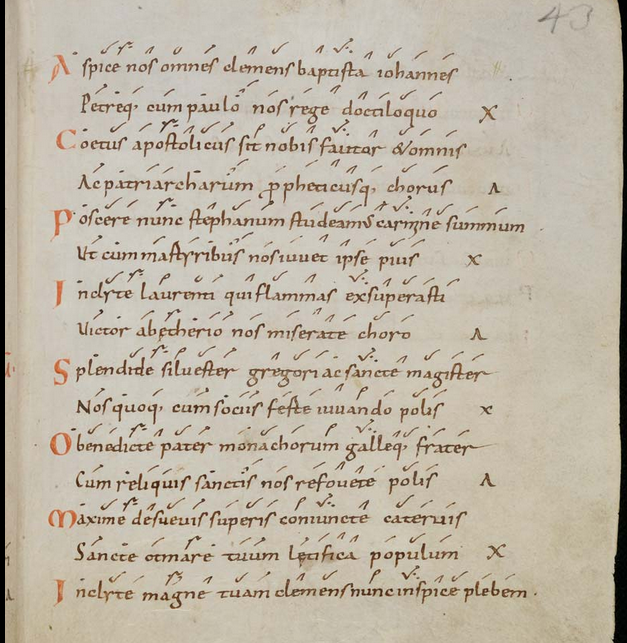
The image in the YouTube video is from the St. Gall manuscript; below  are screenshots from that same manuscript of all four pages (!) of this hymn.  I do not at the moment have an English translation, but will return if I find one (or can work it out myself!).    Spes mundi is "hope of the world" - and Google Translate says that Ardua spes mundi translates as "towering hope of the world":


"Happy World Organ Day"

Today at the Chant Café:
Today, hundreds of concerts will take place around the world to celebrate the 850th anniversary of the founding of the Paris Cathedral. This one in Boston is among them.