Saturday, November 29, 2014

J.S. Bach's Kantata BWV 61: Nun komm, der Heiden Heiland ("Now come, Savior of the Gentiles")

Very likely from the same splendid concert at which the Bach Magnificat was recorded, here's a video of this Advent Cantata:


About the piece:
BWV 61 is a church cantata by Johann Sebastian Bach. He composed it in Weimar for the first Sunday in Advent and first performed it on 2 December 1714.
 
From Bach-Cantatas.com, here's the German text:
Nun komm, der Heiden Heiland I
1. Coro

Violino I/II, Viola I/II, Fagotto, Continuo

Nun komm, der Heiden Heiland,

Der Jungfrauen Kind erkannt,

Des sich wundert alle Welt,

Gott solch Geburt ihm bestellt.

2. Recitativo T

Continuo
Der Heiland ist gekommen,

Hat unser armes Fleisch und Blut

An sich genommen

Und nimmet uns zu Blutsverwandten an.

O allerhöchstes Gut,

Was hast du nicht an uns getan?

Was tust du nicht

Noch täglich an den Deinen?

Du kömmst und lässt dein Licht

Mit vollem Segen scheinen.
3. Aria T

Violino I/II, Viola I/II, Continuo
Komm, Jesu, komm zu deiner Kirche

Und gib ein selig neues Jahr!

    Befördre deines Namens Ehre,

    Erhalte die gesunde Lehre

    Und segne Kanzel und Altar!
4. Recitativo B

Violino I/II, Viola I/II, Continuo
Siehe, ich stehe vor der Tür
und klopfe an. So jemand meine Stimme hören wird und die Tür
auftun, zu dem werde ich eingehen und das Abendmahl mit ihm halten
und er mit mir.
5. Aria S

Violoncelli, Continuo
Öffne dich, mein ganzes Herze,

Jesus kömmt und ziehet ein.

    Bin ich gleich nur Staub und Erde,

    Will er mich doch nicht verschmähn,

    Seine Lust an mir zu sehn,

    Dass ich seine Wohnung werde.

    O wie selig werd ich sein!
6. Choral

Viola I coll' Alto, Viola II col Tenore, Fagotto col Basso, Violino I/II, Continuo

Amen, amen!

Komm, du schöne Freudenkrone, bleib nicht lange!

Deiner wart ich mit Verlangen.


And an English translation:


BWV 61 Nun komm, der Heiden Heiland I


First Sunday in Advent.

Erdmann Neumeister, Geistliche Poesien (Eisenach, 1714) and Fünffache
Kirchenandachten
(Leipzig, 1717); Facs: Neumann T, p. 293.

1. Martin Luther, verse 1 of the German adaptation of Veni redemptor
gentium, 1524 (Wackernagel, III, #16); 4. Rev. 3:20; 6. Philipp Nicolai,
conclusion (Abgesang) of the last verse of Wie schön leuchtet
der Morgenstern, 1599.

2 December 1714, Weimar.

BG 16; NBA I/1.


1. Ouverture [Chorale] (S, A, T, B)

Now come, the gentiles' Savior,

As the Virgin's child revealed,

At whom marvels all the world

That God him this birth ordained.

2. Recit. (T)

To us is come the Savior,

Who hath our feeble flesh and blood

Himself
now taken

And taketh us as kinsmen of his blood.

O treasure unexcelled,


What hast thou not for us then done?

What dost thou not

Yet daily for thy
people?

Thy coming makes thy light

Appear with richest blessing.

3. Aria (T)

Come, Jesus, come to this thy church now

And fill with blessing the
new year!

    Advance thy name in rank and honor,
    Uphold thou ev'ry wholesome doctrine,
    The pulpit and the altar bless!
4. Recit. [Dictum] (B)(1)

See now, I stand before the door and on it knock. If anyone my voice
will render heed and make wide the door, I will come into his dwelling
and take with him the evening supper, and he with me.

5. Aria (S)

Open wide, my heart and spirit,

Jesus comes and draws within.

    Though I soon be earth and ashes,
    Me he will yet not disdain,
    That his joy he find in me
    And that I become his dwelling.
    Oh, how blessed shall I be!
6. Chorale (S, A, T, B)

Amen, amen!

Come, thou lovely crown of gladness, do not tarry(2).

Here
I wait for thee with longing.


1. Representing the vox Christi.

2. In the alto and tenor parts where necessary: come, and do not
tarry.


© Copyright  Z.
Philip Ambrose

Sunday, November 2, 2014

Missa pro Defunctis: Kyrie Eleison (Kyrie from the Mass for the Dead)

For All Souls' Day, here is the Kyrie from the Mass for the Dead, sung here by the Alfred Deller Consort.


Lord, have mercy.
Christ, have mercy.
Lord, have mercy.

Here's Durufle's beautiful composed version; notes at the YouTube page say that it's sung by the Yale Glee Club (Jeffrey Douma, Music Director) along with the Elm City Girls Choir (Rebecca Rosenbaum, Music Director). And it's a wonderful collaboration:


Here are links to posts on Chantblog, for all the movements of the Requiem mass:

Friday, October 31, 2014

The Gradual for the Solemnity of All Saints: Timete Dominum omnes sancti ejus ("Fear the Lord, all ye his saints")

That's the first piece on this video, which I believe is sung by the Chœur Grégorien de Paris. (The video itself seems to be a visual tour of the St. Trophime Cathedral in Arles, France; the chant seems unrelated, to me, possibly used as background music simply for its beauty.  Well, enjoy it!  There are several different pieces on this video - and the church is indeed splendid.):


Here's an mp3 of Timete Dominum from ChristusRex,org,  sung by the Benedictines in São Paulo, Brazil.  And somebody's put the same audio file into a video:


The text, taken from Psalm (33/)34, vv. (10-11/)9-10, from CPDL:
Timete Dominum omnes sancti ejus: quoniam nihil deest timentibus eum.
Inquirentes autem Dominum, non deficient omni bono. Alleluia.

Fear the Lord, all ye his saints: for there is no want to them that fear him:
They that seek the Lord shall not be deprived of any good. Alleluia.

And here is the full chant score:


This text has been set by a number of composers.  Here's one setting by Ascanio Trombetti (1544-1590):


Very nice!   The YouTube page has more about the performance:
Live performance at De Duif, Amsterdam - December 21, 2010
Project "Sacrae Symphoniae" - Vocal and instrumental Renaissance music from Venice

Harma Everts & Klaartje van Veldhoven, sopranos
Santiago Cumplido del Castillo, countertenor
Bram Verheijen & Esteban Manzano, tenors
Eiji Miura, bass

The Royal Wind Music directed by Paul Leenhouts

Petri Arvo, Alana Blackburn, Stephanie Brandt, Ruth Dyson, Eva Gemeinhardt, Arwieke Glas, Hester Groenleer, Karin Hageneder, Kyuri Kim, Marco Paulo Alves Magalhâes, María Martínez Ayerza, Filipa Margarida da Silveira Pereira, Anna Stegmann: renaissance recorders

www.royalwindmusic.org


The All Saints' Day Collect is this one:
Almighty God, you have knit together your elect in one communion and fellowship in the mystical body of your Son Christ our Lord: Give us grace so to follow your blessed saints in all virtuous and godly living, that we may come to those ineffable joys that you have prepared for those who truly love you; through Jesus Christ our Lord, who with you and the Holy Spirit lives and reigns, one God, in glory everlasting. Amen.
Hatchett's Commentary on the American Prayer Book says this about the collect:
This collect was composed for the 1549 Book.  The 1662 revision substituted "blessed" for "holy," and "in all virtuous and godly living" for "in all virtues, and godly living."  The present revision replaces "unspeakable" with "ineffable" since "unspeakable" has so changed and negative a connotation in modern English.  The collect expresses in an admirable way Saint Paul's conception of the church as the Body of Christ.

Here are mp3 files for all the propers on the day, from ChristusRex.org:
Die 1 novembris
Omnium Sanctorum
Introitus: Ps. 32 Gaudeamus... Sanctorum omnium (3m09.8s - 2969 kb) score
Graduale: Ps. 33, 10. V. 11b Timete Dominum (2m33.1s - 2395 kb) score
Alleluia: Mt. 11, 28 Venite ad me (3m34.5s - 3355 kb) score
Offertorium: Sap. 3, 1.2.3 Iustorum animæ (2m25.8s - 2281 kb) score
Communio: Mt. 5, 8.9.10 Beati mundo corde (1m29.8s - 1408 kb) score

And here are posts about these on Chantblog:

Here's an interesting icon appropriate for this day.  It's described this way:  "Icon of Chetyi-Minei (calendar of saints).  In the very center is the Resurrection of Christ surrounded by scenes from Holy Week and the feasts of the Paschal cycle. Around them are twelve groupings of saints: one for each month of the calendar year. In the border are icons of the Theotokos (Mother of God), each of which has a feast day during the liturgical year."


Friday, October 24, 2014

New York Polyphony: Nesciens mater (Byttering)

NYP offered this beautiful video in its socmed feeds today:


CPDL says the text is taken from a Christmastide antiphon:
Nesciens mater virgo virum
peperit sine dolore
salvatorem saeculorum.
Ipsum regem angelorum
sola virgo lactabat,
ubere de caelo pleno.

(some sources have ubera de coelo plena)
Knowing no man, the Virgin mother
bore, without pain,
the Saviour of the world.
Him, the king of angels,
only the Virgin suckled,
breasts filled by heaven. 


This is Byttering's Wikipedia entry:
Byttering (also Bytering, Bytteryng, or Biteryng; possible first name Thomas) (fl. c. 1400 – 1420) was an English composer during the transitional period from Medieval to Renaissance styles. Five of his compositions have survived, all of them in the Old Hall Manuscript.

A possible identification of Byttering with a Thomas Byteryng has been made. Byteryng was a canon at Hastings Castle between 1405 and 1408, and was a rector somewhere in London in 1414. There is no information on the composer in the Old Hall Manuscript other than that his surname is attached to several pieces. Those pieces stand out from many of the works in the manuscript by their relatively advanced stylistic traits.

Byttering's music includes three mass sections – two Glorias and a Credo – a motet based on Nesciens Mater, and a substantial three-voice, isorhythmic wedding motet, En Katerine solennia/Virginalis contio/Sponsus amat sponsum, his best-known work, which was almost certainly written for the wedding, on 2 June 1420, of King Henry V and Catherine of Valois.

The four-voice Gloria, No. 18 in the Old Hall MS, is one of the most complex canons of the early 15th century, and represents what was probably the extreme of stylistic differentiation between English and continental practice. Canons in continental sources are extremely rare, but there are seven in the Old Hall MS, and Byttering's is the only one with the standard arrangement of the same tune in all four voices.

Monday, October 20, 2014

And Yet Another Tiresome Episcopal Drama.....

Is there a petition I can sign that would get rid of the entire "leadership" - and I use that term  loosely - at General Theological Seminary?   The entire cast of characters involved in this incident - faculty, Dean, and Board - have all clearly demonstrated their incompetence and unsuitability for the positions they hold. 

This latest Baby Boomer Episcopalian drama is by far the most ridiculous thing I've seen in my 10 years of church membership - and that's really saying something.   With everything that's going on in the world today - including the imminent failure of the church itself - I simply cannot believe a few Episcopal clergypeople have found still another way to obsess over themselves, and have now suckered the entire church into the mess.

I've completely lost respect for all the "outraged commentators" too.  "Weaponization of resignation," indeed!  Sure - when you hold the gun to your own head.  8 brain-dead morons give the institution that employs them an ultimatum:  "Either the Boss goes, or we do."   Why is anybody shocked, shocked that the Board of Directors decided - quite rightly, too, in my estimation -  "Well, in that case, you go, then.  And don't let the door hit you on the way out."?  (And we get lectures on "dishonesty"!  As if the 8 morons were just minding their own business one day and happened to get fired, for no reason at all.)

Again, I am always utterly astounded that clergy do things their parishioners would never even consider doing in our worklives - and somehow expect to escape the consequences of it.  I'm even more amazed the lengths to which people are going now to make excuses for it.

I'm quite sure there's more to this than we are being told - it couldn't really be this ridiculous, could it? - but at this point, why should anybody care?   Show them all the door, and start over.

The Episcopal Church is, I'm sorry to say, drunk.  Hopefully it will hit bottom sometime soon - but don't hold your breath.....

    Sunday, October 19, 2014

    "Hail true body, born of Mary": Plainsong from the Guildford Cathedral Choir

    I just became aware of "Archives of Sound," a YouTube channel apparently completely dedicated to videos (which are actually audio files along with still images) from the "Guildford Cathedral Choir (1961-1974) during Barry Rose's tenure as Organist & Master of the Choristers."    I'm quite sure I'll be posting from this collection fairly often; there's lots of Anglican Chant.

    This is a lovely recording of an English-language version of the Gregorian chant Eucharistic hymn Ave Verum Corpus, recorded at Guildford Cathedral in May of 1967:


    These are the words they are using here; I haven't been able to determine their provenance:

    Hail, true body, born of Mary,
    by a wondrous virgin birth.
    Thou who on the cross wast offered
    to redeem the sons of earth;

    Thou whose side became a fountain
    pouring forth thy precious blood,
    give us now; and at our dying,
    thine own self to be our food.

    O sweetest Jesu,
    O gracious Jesu,
    O Jesu, blessed Mary's Son.

    Wikipedia has the Latin words, along with a more literal English translation:
    Ave verum corpus, natum
    de Maria Virgine,
    vere passum, immolatum
    in cruce pro homine
    cuius latus perforatum
    fluxit aqua et sanguine:
    esto nobis praegustatum
    in mortis examine.
    O Iesu dulcis, O Iesu pie,
    O Iesu, fili Mariae.
    Miserere mei. Amen.
    Hail, true Body, born
    of the Virgin Mary,
    who having truly suffered, was sacrificed
    on the cross for mankind,
    whose pierced side
    flowed with water and blood:
    May it be for us a foretaste [of the Heavenly banquet]
    in the trial of death.
    O sweet Jesus, O pious Jesus,
    O Jesus, son of Mary,
    have mercy on me. Amen.


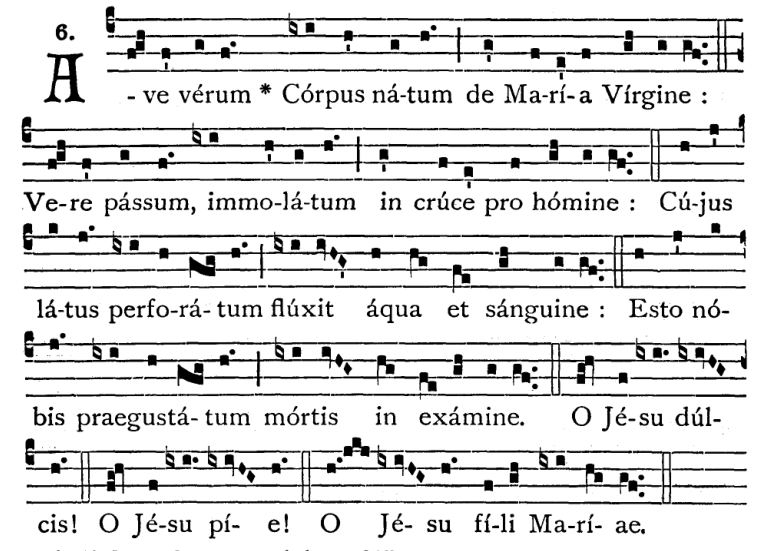
    Here's the score of the chant in Latin from the Liber Usualis:


    More about this hymn, from the same Wikipedia link above:
    "Ave verum corpus" is a short Eucharistic hymn that has been set to music by various composers. It dates from the 14th century and has been attributed to Pope Innocent VI.[1]

    During the Middle Ages it was sung at the elevation of the host during the consecration. It was also used frequently during Benediction of the Blessed Sacrament.

    The hymn's title means "Hail, true body", and is based on a poem deriving from a 14th-century manuscript from the Abbey of Reichenau, Lake Constance.[citation needed] The poem is a meditation on the Catholic belief in Jesus's Real Presence in the sacrament of the Eucharist, and ties it to the Catholic conception of the redemptive meaning of suffering in the life of all believers.


    Barry Rose has written choral music, too; I've sung some of his Responses, for Mattins or Evensong (I can't quite recall at the moment).

    I had actually never heard the Gregorian version of this song until today - but I have heard many composed versions.  Most famous, perhaps, is the Mozart version, here sung by King's College, Cambridge:


    William Byrd also set this hymn:


    Another well-known polyphonic setting is Edward Elgar's:


    This is one I've just heard for the first time; interestingly, it seems only to be available on Chinese video sites!  And so, I'm not sure who the composer is, but the singers are the Salisbury Cathedral Choristers:


    Clearly a more contemporary setting; if I learn more about it, I'll come back to post again.